Demain, je vais pêcher
A restorer who thinks before he speaks, and a village full of plans.
Sunday morning. Julien arrives on the first train with a small case of tools, and he does what he always does: he looks, and he thinks. Everyone else makes plans. Marc walks back to the harbour to ask Lucien one more question, and on the way home he stops in front of a small blue house, a little too long.
Texte

Julien arrive
Dimanche, dix heures. Julien arrive au Poisson rouge avec une petite valise.
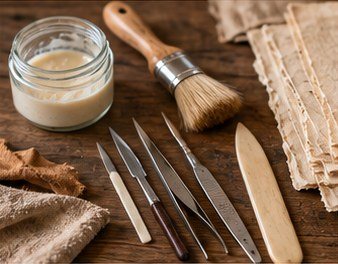
Dans la valise, il y a ses outils : des pinceaux, de la colle, une spatule. Il pose le carnet sur la table. Il regarde. Il regarde longtemps. Cinq minutes. Dix minutes. Personne ne parle.
Théo ne peut pas rester tranquille : « Alors ? Alors ? »
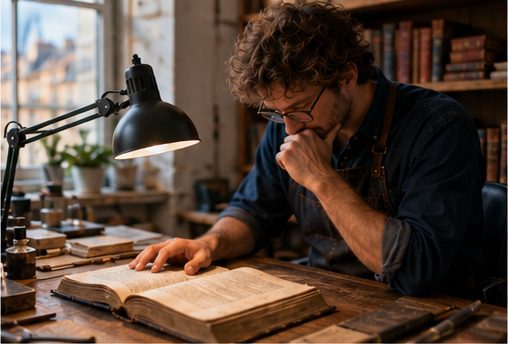
Julien lève la tête : « Je vais réfléchir. »
Tout le monde soupire.
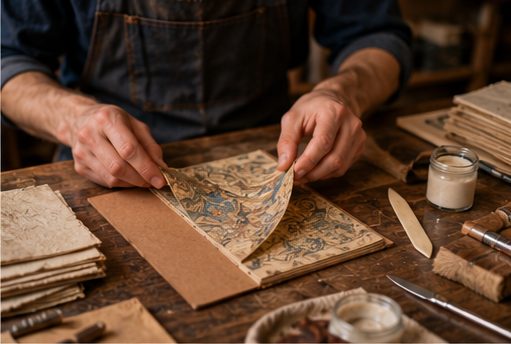
Puis Julien explique son plan. D’abord, il va regarder le papier, page par page. Ensuite, il va séparer les pages avec la spatule, une par une. Et il va prendre son temps, parce que le papier est très fragile.
Tout le monde fait des plans pour la journée. Sophie et Camille vont visiter le village. Véronique va préparer le déjeuner. Théo va inviter Inès au cinéma. Enfin, il va essayer.
Marc, lui, retourne au port. Il va parler à Lucien.
À midi, Marc, Sophie et Camille rentrent ensemble. Devant le port, Sophie s’arrête. Il y a une petite maison bleue, et sur la porte, un panneau : À VENDRE
Sophie regarde la maison. Puis elle regarde Marc.
Marc regarde la maison. Un peu trop longtemps.
Le plan de Julien
Marc : Ça va prendre combien de temps ?
Julien : Deux jours. Peut-être trois.
Marc : Trois jours ? Mais je pars mercredi !
Julien : Justement. Mercredi, c’est dans trois jours.
Camille : Et nous, Sophie, on va faire quoi ?
Sophie : On va visiter le village. Et on va manger une glace.
Théo : Moi, cet après-midi, je vais inviter Inès au ciné.
Véronique : Ah oui ? Et cette fois, tu vas dire quelque chose ?
Théo : Je vais dire « Salut ». C’est un bon début, non ?
Au port
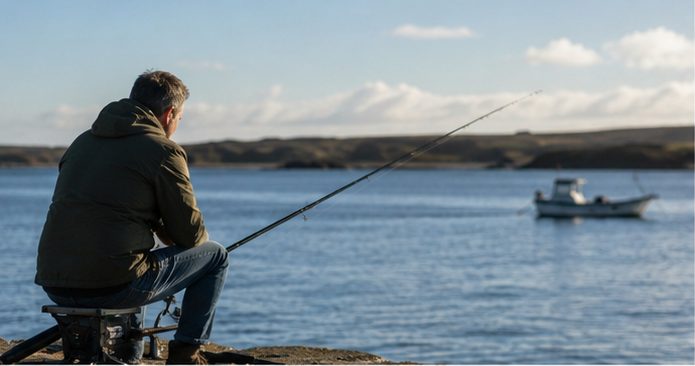
Marc : Bonjour, Lucien. Vous allez pêcher demain ?
Lucien : Oui.
Marc : Au rocher noir ?
Lucien : …
Marc : Je vais être honnête avec vous : je ne prends jamais rien.
Lucien : Je sais.
Marc : Tout le monde sait ?
Lucien : Tout le monde.
Hover any word for its sound and its English, or read the whole text in English first. Sunday, ten o’clock. Julien arrives at Le Poisson rouge with a small suitcase. In the suitcase are his tools: brushes, glue, a spatula. He puts the notebook down on the table. He looks. He looks for a long time. Five minutes. Ten minutes. Nobody speaks. Théo cannot keep still: "So? So?" Julien looks up: "I am going to think about it." Everybody sighs. Then Julien explains his plan. First, he is going to look at the paper, page by page. Then he is going to separate the pages with the spatula, one by one. And he is going to take his time, because the paper is very fragile. Everybody makes plans for the day. Sophie and Camille are going to look round the village. Véronique is going to make lunch. Théo is going to invite Inès to the cinema. Well, he is going to try. Marc, for his part, goes back to the harbour. He is going to talk to Lucien. At midday, Marc, Sophie and Camille walk back together. In front of the harbour, Sophie stops. There is a little blue house, and on the door, a sign: FOR SALE. Sophie looks at the house. Then she looks at Marc. Marc looks at the house. A little too long. JULIEN’S PLAN. MARC: How long is it going to take? JULIEN: Two days. Maybe three. MARC: Three days? But I am leaving on Wednesday! JULIEN: Exactly. Wednesday is in three days. CAMILLE: And what about us, Sophie, what are we going to do? SOPHIE: We are going to look round the village. And we are going to have an ice cream. THÉO: Me, this afternoon, I am going to invite Inès to the cinema. VÉRONIQUE: Oh really? And this time, are you going to say something? THÉO: I am going to say "Hi". It is a good start, isn’t it? AT THE HARBOUR. MARC: Good morning, Lucien. Are you going fishing tomorrow? LUCIEN: Yes. MARC: At the black rock? LUCIEN: … MARC: I am going to be honest with you: I never catch anything. LUCIEN: I know. MARC: Does everybody know? LUCIEN: Everybody.
Mots et expressions
30 mots
| Français | English |
|---|---|
| une petite valise | a small suitcase |
| un outil | a tool |
| un pinceau | a brush |
| la colle | glue |
| une spatule | a spatula |
| longtemps | for a long time |
| personne ne parle | nobody speaks |
| rester tranquille | to keep still, to keep quiet |
| lever la tête | to look up |
| réfléchir | to think (something) over |
| soupirer | to sigh |
| expliquer | to explain |
| d’abord | first |
| ensuite | then, next |
| séparer | to separate |
| une par une | one by one |
| prendre son temps | to take one’s time |
| fragile | fragile |
| faire des plans | to make plans |
| visiter le village | to look round the village |
| préparer le déjeuner | to make lunch |
| inviter quelqu’un au ciné | to invite somebody to the cinema |
| essayer | to try |
| retourner | to go back |
| s’arrêter | to stop |
| un panneau | a sign |
| À VENDRE | for sale |
| une glace | an ice cream |
| justement | exactly, that is the point |
| Ça va prendre combien de temps ? | How long is it going to take? |
Aller + infinitive: the near future
Grammaire 1
To talk about what is going to happen, French does exactly what English does: it uses the verb go. Aller changes with the person; the second verb stays in the infinitive, always.
| aller | + infinitif | English |
|---|---|---|
| je vais | réfléchir | I am going to think it over |
| tu vas | dire quelque chose | you are going to say something |
| il va | essayer | he is going to try |
| nous allons | visiter le village | we are going to look round the village |
| vous allez | pêcher | you are going to fish |
| ils vont | prendre leur temps | they are going to take their time |
Same verb, two jobs. Look at what follows aller.
Marc va au port. A place: he is on his way there now.
Marc va parler à Lucien. An infinitive: it is going to happen.
When, and in what order?
Grammaire 2
| Quand ? | English |
|---|---|
| ce soir | tonight, this evening |
| cet après-midi | this afternoon |
| demain · demain matin | tomorrow · tomorrow morning |
| ce week-end | this weekend |
| mercredi | on Wednesday (this coming one) |
| la semaine prochaine | next week |
| dans trois jours | in three days’ time |
| bientôt | soon |
Mercredi or le mercredi? Without the article it is one Wednesday, the next one: je pars mercredi. With it, it is every Wednesday, as in Émile’s notebook: le mardi, je vais au rocher noir.
Julien tells his plan in order. Four small words do the whole job:
| d’abord | ensuite | après | enfin |
|---|---|---|---|
| first | then, next | after that | finally |
Watch enfin in the text: Théo va inviter Inès au cinéma. Enfin, il va essayer. In speech it also means well…, or rather…, exactly the way Théo uses it.
How it really comes out
J’arrive !
When something is already fixed, French often skips aller and uses the plain present:
Je pars mercredi. I am leaving on Wednesday.
J’arrive à neuf heures et demie. I will be there at half past nine.
J’arrive ! Coming! (shouted from the kitchen)
Je vais + infinitive is for plans, intentions and predictions: Ça va prendre deux jours.
And in fast speech je vais shrinks to j’vais /ʒvɛ/: j’vais réfléchir.
Les expressions du texte · listen and repeat
Twelve sentences about Sunday’s plans. Tap a card to turn it over, the speaker to hear it, the star to keep it in your word bank.
- Je vais réfléchir. /ʒə vɛ ʁe.fle.ʃiʁ/ I am going to think about it.
- Ça va prendre combien de temps ? /sa va pʁɑ̃dʁ kɔ̃.bjɛ̃ də tɑ̃/ How long is it going to take?
- Ça va prendre deux jours. /sa va pʁɑ̃dʁ dø ʒuʁ/ It is going to take two days.
- D’abord, il va regarder le papier. /da.bɔʁ il va ʁə.ɡaʁ.de lə pa.pje/ First, he is going to look at the paper.
- Il va prendre son temps. /il va pʁɑ̃dʁ sɔ̃ tɑ̃/ He is going to take his time.
- Mais je pars mercredi ! /mɛ ʒə paʁ mɛʁ.kʁə.di/ But I am leaving on Wednesday!
- Mercredi, c’est dans trois jours. /mɛʁ.kʁə.di sɛ dɑ̃ tʁwa ʒuʁ/ Wednesday is in three days.
- On va visiter le village. /ɔ̃ va vi.zi.te lə vi.laʒ/ We are going to look round the village.
- Je vais inviter Inès au ciné. /ʒə vɛ ɛ̃.vi.te i.nɛs o si.ne/ I am going to invite Inès to the cinema.
- Tu vas dire quelque chose ? /ty va diʁ kɛl.kə ʃoz/ Are you going to say something?
- Vous allez pêcher demain ? /vu.za.le pɛ.ʃe də.mɛ̃/ Are you going fishing tomorrow?
- Je vais être honnête avec vous. /ʒə vɛ ɛtʁ ɔ.nɛt a.vɛk vu/ I am going to be honest with you.
Un lieu ou le futur ?
The same verb, two jobs. Look at what comes after aller.
Qui va faire quoi ?
Everybody’s plans for Sunday. Choose the form of aller.
Aujourd’hui… Demain…
Move each sentence to tomorrow. Write two words: the form of aller and the infinitive.
Associez la photo et la phrase
Click a photo, then the plan that goes with it.
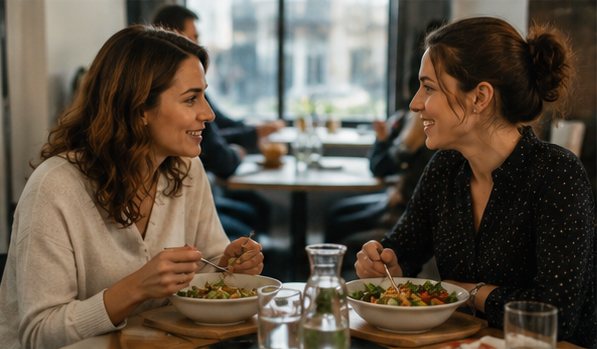
Quand ?
It is Sunday morning. Choose the time word that fits the English.
Vrai ou faux ?
Read the text again and decide.
Qui parle ?
Who says each line?
Et vous, qu’est-ce que vous allez faire ?
Finish each sentence out loud about your own plans. Then click the card for one possible answer : yours will be different.
In pairs: one reads the beginning, the other finishes it, then swap.
Production écrite
Use aller + infinitive in at least five sentences, with three different persons, and two time words from the table: D’abord, je vais prendre un café. Ensuite, mon collègue et moi, nous allons préparer la réunion de lundi.
Plan de l’épisode (нотатки для викладача, 60 хв)
| Час | Етап | Що робимо |
|---|---|---|
| 5 хв | Lead-in | Викладач показує фото Julien і питає: Qu’est-ce qu’il va faire ? Група здогадується; відповіді без граматики теж підходять. |
| 7 хв | Reading for gist | Читають текст і обидва діалоги. Одне запитання: Ça va prendre combien de temps ? Далі Exercice 6. |
| 8 хв | Futur proche | Граматика 1: таблиця, «нічого між двома дієсловами», два приклади з Épisodes 2 і 3. Exercice 1: одне дієслово, дві ролі. |
| 7 хв | Drill | Exercice 2 усно, потім Exercice 3 письмово з самоперевіркою. |
| 6 хв | Quand ? | Граматика 2: слова часу, mercredi проти le mercredi, d’abord / ensuite / enfin. Exercice 5. |
| 5 хв | Photos | Exercice 4 (фото і плани) у парах. |
| 14 хв | Speaking | «Le plan» у парах: один розповідає план на завтра з d’abord / ensuite / enfin, другий питає Ça va prendre combien de temps ? і Tu vas… ?. Потім розіграти діалог «Au port»: Lucien відповідає лише одним словом. |
| 8 хв | Wrap-up | Exercice 7 на слух. Блок «How it really comes out»: J’arrive !, Je pars mercredi. Домашнє: Production écrite і Exercice 8. |