Je ne vais pas rester
Just a visit. Just to look. Nobody is going to buy anything.
Sunday afternoon. Sophie is on holiday, but she is also an estate agent, and there is a house for sale. By four o’clock she has the keys. Marc comes along, just to look. In the evening Julien frees the first stuck page of the notebook, and it is not the map everybody was waiting for.
Texte
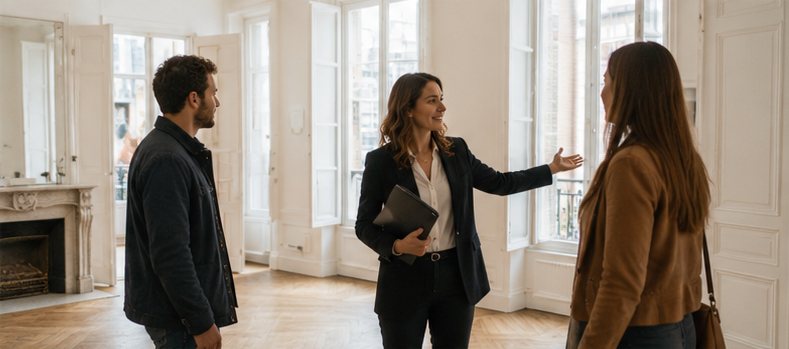
La maison bleue
Dimanche, trois heures. Sophie est en vacances. Mais Sophie est aussi agente immobilière, et une maison à vendre, c’est plus fort qu’elle.

Elle téléphone au propriétaire. À quatre heures, elle a les clés. « Nous n’allons pas acheter, dit-elle. Nous allons juste regarder. »
Marc vient avec elle. Juste pour regarder, lui aussi. Camille vient aussi, pour les photos.
La maison est petite, mais très lumineuse. En bas, il y a le salon et la cuisine. En haut, il y a une chambre et une petite salle de bains. Et de la chambre, on voit la mer.
Marc ne dit rien. Il reste longtemps devant la fenêtre.
Théo passe devant la maison. Par hasard, bien sûr.
Le soir, au Poisson rouge, Théo raconte tout : la maison bleue, les clés, Marc devant la fenêtre. Véronique ne dit rien. Mais elle sourit.
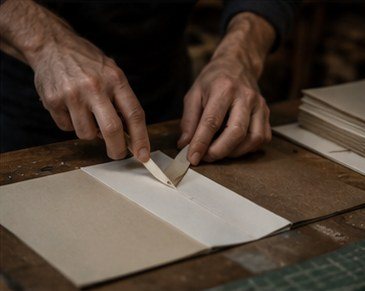
Puis Julien sépare la première page collée. Tout le monde regarde. Véronique est à côté de Marc. Sur la page, il n’y a pas de carte. Il y a une phrase d’Émile :
« Le rocher noir ? Regarde avec les yeux du poisson rouge. »
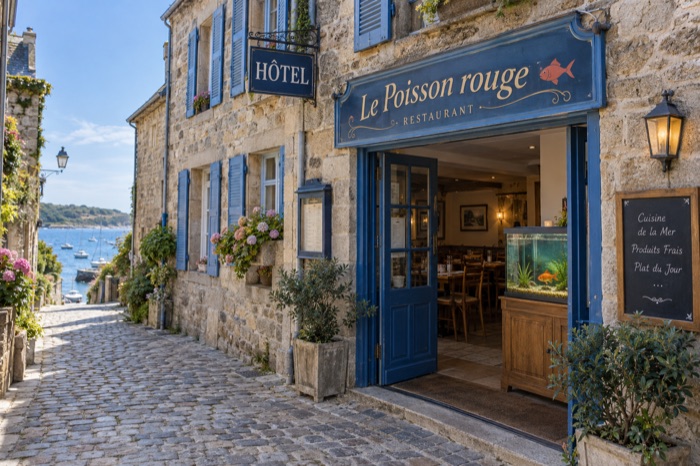
Tout le monde regarde l’aquarium. Gustave, lui, ne dit rien.
La visite
Sophie : Alors, ici, c’est le salon. La cuisine est à côté.
Marc : C’est petit.
Sophie : C’est charmant. Et maintenant… la chambre.
Marc : Oh. La mer.
Sophie : La mer, tous les matins.
Marc : Sophie, je vais pas rester ici, hein. Je suis en vacances.
Sophie : Bien sûr. Vous n’allez pas rester.
Marc : Et… c’est combien ?
Sophie : Vous allez rire.
Marc : Non. Je vais pleurer.
Camille : Et cet hiver, qu’est-ce que vous allez faire, à Cambridge ?
Marc : Je vais travailler. Et je vais avoir froid.
À la fenêtre
Théo : Il va acheter la maison ! Moi, je sais tout !
Marc : Je ne vais rien acheter du tout !
Sophie : Et toi, Théo, tu ne vas pas inviter Inès au cinéma ?
Théo : Si, si. Demain.
Camille : Demain, demain… Comme les poissons de Marc.
Hover any word for its sound and its English, or read the whole text in English first. Sunday, three o’clock. Sophie is on holiday. But Sophie is also an estate agent, and a house for sale is more than she can resist. She phones the owner. At four o’clock she has the keys. "We are not going to buy," she says. "We are just going to look." Marc comes with her. Just to look, he too. Camille comes as well, for the photos. The house is small, but full of light. Downstairs there is the living room and the kitchen. Upstairs there is a bedroom and a small bathroom. And from the bedroom you can see the sea. Marc says nothing. He stays at the window for a long time. Théo walks past the house. By chance, of course. In the evening, at Le Poisson rouge, Théo tells everything: the blue house, the keys, Marc at the window. Véronique says nothing. But she smiles. Then Julien separates the first stuck page. Everybody watches. Véronique is next to Marc. On the page there is no map. There is one sentence from Émile: "The black rock? Look with the eyes of the goldfish." Everybody looks at the fish tank. Gustave, for his part, says nothing. THE VIEWING. SOPHIE: So, this is the living room. The kitchen is next door. MARC: It is small. SOPHIE: It is charming. And now… the bedroom. MARC: Oh. The sea. SOPHIE: The sea, every morning. MARC: Sophie, I am not going to stay here, you know. I am on holiday. SOPHIE: Of course. You are not going to stay. MARC: And… how much is it? SOPHIE: You are going to laugh. MARC: No. I am going to cry. CAMILLE: And this winter, what are you going to do, in Cambridge? MARC: I am going to work. And I am going to be cold. AT THE WINDOW. THÉO: He is going to buy the house! I know everything! MARC: I am not going to buy anything at all! SOPHIE: And you, Théo, aren’t you going to invite Inès to the cinema? THÉO: Yes, yes, I am. Tomorrow. CAMILLE: Tomorrow, tomorrow… Like Marc’s fish.
Mots et expressions
30 mots
| Français | English |
|---|---|
| une agente immobilière | an estate agent (a woman) |
| une maison à vendre | a house for sale |
| c’est plus fort qu’elle | she cannot help it |
| le propriétaire | the owner |
| les clés | the keys |
| acheter | to buy |
| juste pour regarder | just to look |
| lumineux, lumineuse | full of light, bright |
| en bas | downstairs |
| en haut | upstairs |
| le salon | the living room |
| la cuisine | the kitchen |
| la chambre | the bedroom |
| la salle de bains | the bathroom |
| on voit la mer | you can see the sea |
| rester | to stay |
| passer devant | to walk past |
| par hasard | by chance |
| charmant, charmante | charming |
| tous les matins | every morning |
| C’est combien ? | How much is it? |
| rire | to laugh |
| pleurer | to cry |
| cet hiver | this winter |
| avoir froid | to be cold |
| ne… rien du tout | nothing at all |
| une phrase | a sentence |
| les yeux | the eyes |
| Si ! | Yes! (answering a negative question) |
| …, hein ? | …, right? …, you know? |
Not going to
Grammaire 1
Ne… pas goes around aller, never around the infinitive. Aller carries the sentence; the infinitive is only its luggage, and the luggage stays outside.
| ne + aller + pas | + infinitif |
|---|---|
| je ne vais pas | rester |
| tu ne vas pas | inviter Inès ? |
| il ne va rien | acheter |
| nous n’allons pas | acheter |
| vous n’allez pas | rester |
| ils ne vont jamais | partir |
Asking about plans
Grammaire 2
The same question can be asked three ways. All three are correct; they are not used in the same places.
| Question | Where you hear it |
|---|---|
| Vous allez faire quoi ? | spoken; the question word goes to the end, as in Épisode 5 |
| Qu’est-ce que vous allez faire ? | correct everywhere: the safe choice |
| Qu’allez-vous faire ? | written and formal: recognise it, no need to say it |
For a yes / no question there are two ways:
| Tu vas venir ? | just raise your voice at the end: the way people talk |
| Est-ce que tu vas venir ? | correct everywhere, a little more careful |
Vous allez faire quoi ? · Qu’est-ce que vous allez faire ? · Tu vas venir ?
Qu’est-ce que is said as one short word: /kɛs.kə/.
Si: the yes that answers a no
Grammaire 3
English answers “Aren’t you going to invite her?” with “Yes, I am”. French has a special word for that yes.
| Question | Yes | No |
|---|---|---|
| Tu vas inviter Inès ? | Oui. | Non. |
| Tu ne vas pas inviter Inès ? | Si ! | Non. |
How it really comes out
Je vais pas rester, hein.
Marc already speaks like a Frenchman: je vais pas rester, hein.
The ne is gone (je vais pas = je ne vais pas), and hein at the end asks for agreement, like you know or right?. Sophie answers with the full, careful form. Both are French; one of them is what you will hear in the street.
And one phrase worth stealing: c’est plus fort que moi, “I can’t help it”. A house for sale is to Sophie what a question is to Théo.
Les expressions du texte · listen and repeat
Twelve sentences from the viewing. Tap a card to turn it over, the speaker to hear it, the star to keep it in your word bank.
- Nous n’allons pas acheter. /nu na.lɔ̃ pa a.ʃə.te/ We are not going to buy.
- Nous allons juste regarder. /nu.za.lɔ̃ ʒyst ʁə.ɡaʁ.de/ We are just going to look.
- Une maison à vendre, c’est plus fort qu’elle. /yn mɛ.zɔ̃ a vɑ̃dʁ sɛ ply fɔʁ kɛl/ A house for sale: she cannot help herself.
- De la chambre, on voit la mer. /də la ʃɑ̃bʁ ɔ̃ vwa la mɛʁ/ From the bedroom you can see the sea.
- Je ne vais pas rester ici. /ʒə nə vɛ pa ʁɛs.te i.si/ I am not going to stay here.
- Et c’est combien ? /e sɛ kɔ̃.bjɛ̃/ And how much is it?
- Vous allez rire. /vu.za.le ʁiʁ/ You are going to laugh.
- Non. Je vais pleurer. /nɔ̃ ʒə vɛ plœ.ʁe/ No. I am going to cry.
- Qu’est-ce que vous allez faire cet hiver ? /kɛs.kə vu.za.le fɛʁ sɛ.ti.vɛʁ/ What are you going to do this winter?
- Je vais avoir froid. /ʒə vɛ a.vwaʁ fʁwa/ I am going to be cold.
- Je ne vais rien acheter du tout ! /ʒə nə vɛ ʁjɛ̃ a.ʃə.te dy tu/ I am not going to buy anything at all!
- Tu ne vas pas l’inviter ? Si, si. /ty nə va pa lɛ̃.vi.te si si/ Aren’t you going to invite her? Yes, yes, I am.
Où va le « ne… pas » ?
Only one sentence in each group is French. Find the sandwich: ne + aller + pas.
Non, non et non !
Marc says no to everything. Write the missing words.
Parlé, standard ou écrit ?
Where would you hear each question: in the street, anywhere, or in a formal letter?
Oui, si ou non ?
The English tells you what the answer means. Choose the French word.
Regardez la photo et répondez
Sunday afternoon and Sunday evening, in three pictures.
Trois heuresLa visiteLe soirVrai ou faux ?
Read the text again and decide.
Qui parle ?
Who says each line?
Et vous ?
Finish each sentence out loud, or answer the question. Then click the card for one possible answer : yours will be different.
In pairs: one reads the beginning, the other finishes it, then swap.
Production écrite
Then add three sentences about what you are going to do there and two about what you are not going to do there: Je ne vais pas regarder la télé : je vais regarder la mer.
Plan de l’épisode (нотатки для викладача, 60 хв)
| Час | Етап | Що робимо |
|---|---|---|
| 5 хв | Lead-in | Нагадуємо кінець Épisode 9: табличка À VENDRE. Питання: Marc va acheter la maison ? Група голосує: oui / non. |
| 7 хв | Reading for gist | Читають текст і діалоги. Одне запитання: Qu’est-ce qu’il y a sur la première page ? Далі Exercice 6. |
| 8 хв | Ne… pas | Граматика 1: «сендвіч» ne + aller + pas, місце rien і jamais. Exercice 1. |
| 7 хв | Drill | Exercice 2 письмово, самоперевірка. Потім швидко усно: викладач каже план, група заперечує. |
| 6 хв | Questions | Граматика 2 і Exercice 3: три способи спитати, де що звучить. |
| 5 хв | Si | Граматика 3 і Exercice 4. Викладач ставить групі заперечні питання, група відповідає Si ! або Non. |
| 14 хв | Speaking | Рольова гра «La visite» у трійках: агент, покупець, друг покупця. Агент показує кімнати (en bas, en haut, à côté), покупець увесь час каже Je ne vais pas acheter…, друг питає Qu’est-ce que tu vas faire ? |
| 8 хв | Wrap-up | Exercice 5 і 7. Обговорюємо загадку Émile: що бачить Gustave? Домашнє: Production écrite і Exercice 8. |