Je vais, tu vas, ils vont
Everybody is going somewhere. Grandfather Émile went there first, in 1952.
Saturday afternoon. The whole hotel goes out, except Véronique, who stays behind with her grandfather’s notebook. Émile wrote his week in the present tense, the way people write a diary, and he went to a great many places. One of them nobody has found since.
Les personnages
2 voix
Émile, Véronique’s grandfather, the fisherman who opened Le Poisson rouge. He is only a voice in this story: the voice of his notebook, written in the summer of 1952.
Julien, Sophie’s cousin, the book restorer from Bordeaux (Épisode 2). Last night he celebrated his best friend’s birthday. Tonight he is on the phone, and he needs to think about it.
Texte
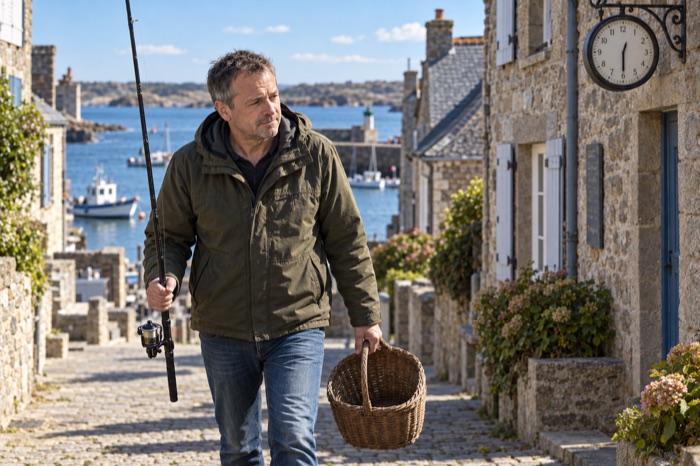
Samedi après-midi
Samedi, deux heures. Au Poisson rouge, tout le monde va quelque part.
Sophie et Camille vont à la plage. Marc va au port : il veut parler aux pêcheurs du rocher noir. Théo va à la boulangerie. Encore.

Véronique, elle, ne va nulle part. Elle reste au restaurant avec le carnet de son grand-père. Le carnet est vieux et abîmé. Émile raconte sa semaine au présent, jour après jour.
Lundi 2 juin 1952. Beau temps. Je vais au port à cinq heures. À dix heures, je vais au marché avec mes poissons.
Mardi 3 juin. Je vais au rocher noir avec le petit Lucien. Il a huit ans et il ne parle pas. Les poissons vont et viennent. Trois bars !
Mercredi 4 juin. Je vais chez le docteur. Encore mon dos.
Dimanche 8 juin. Le matin, nous allons tous à la messe. Le petit Lucien aussi. Il ne parle pas, même à l’église.
Le rocher noir ? Je ne dis rien à personne. Seul Lucien sait.
Le petit Lucien… Véronique sourit. Aujourd’hui, le petit Lucien a quatre-vingt-deux ans.
Mais la page suivante est collée. Le papier est trop abîmé : Véronique ne peut pas ouvrir la page.
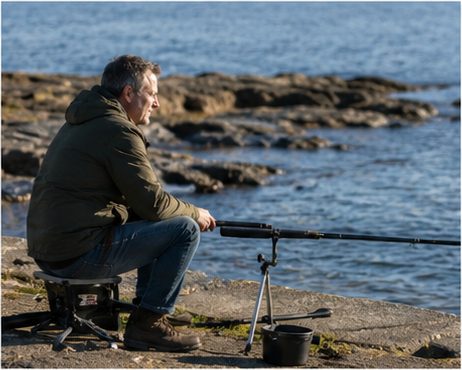
À quatre heures, Marc rentre du port. Les pêcheurs ne savent rien. Ou ils ne disent rien. Il s’assoit à côté de Véronique, et ils regardent le carnet ensemble. Longtemps.
À six heures, Sophie et Camille rentrent de la plage. Sophie regarde la page collée : « Je connais quelqu’un. Mon cousin Julien. Il restaure des livres anciens, à Bordeaux. »
On y va !
Camille : Marc ! On va à la plage. Vous allez où, vous ?
Marc : Moi, je vais au port.
Camille : Au port ? Pour pêcher ?
Marc : Non. Pour poser des questions.
Véronique : Et toi, Théo, tu vas où ?
Théo : Je vais… à la boulangerie.
Véronique : Encore ? Nous avons douze croissants !
Théo : Alors je vais chez Inès. Euh… à la boulangerie.
Véronique : Bien sûr.
Camille : Bon, Sophie, on y va ?
Au téléphone
Sophie : Allô, Julien ? C’est Sophie. Ça va ?
Julien : Ça va. Un peu fatigué. Tu sais, le restaurant Michelin, hier soir…

Sophie : Ah oui ! Alors ?
Julien : Trop bon. Et trop cher.
Sophie : Écoute, on a un problème. Un vieux carnet, de 1952. Les pages sont collées.
Julien : Vous êtes où ?
Sophie : Au bord de la mer, à deux heures de Bordeaux. Tu peux venir demain ?
Julien : … Je réfléchis.
Sophie : Julien !
Julien : Bon, bon. Je vais à la gare à sept heures. J’arrive à neuf heures et demie.
Sophie : Merci ! Tu es un amour.
Hover any word for its sound and its English, or read the whole text in English first. Saturday, two o’clock. At Le Poisson rouge, everybody is going somewhere. Sophie and Camille are going to the beach. Marc is going to the harbour: he wants to talk to the fishermen about the black rock. Théo is going to the bakery. Again. Véronique, for her part, is not going anywhere. She stays in the restaurant with her grandfather’s notebook. The notebook is old and damaged. Émile tells his week in the present tense, day after day. MONDAY 2 JUNE 1952. Fine weather. I go to the harbour at five. At ten, I go to the market with my fish. TUESDAY 3 JUNE. I go to the black rock with little Lucien. He is eight and he does not talk. The fish come and go. Three sea bass! WEDNESDAY 4 JUNE. I go to the doctor’s. My back again. SUNDAY 8 JUNE. In the morning we all go to Mass. Little Lucien too. He does not talk, not even in church. The black rock? I say nothing to anybody. Only Lucien knows. Little Lucien… Véronique smiles. Today little Lucien is eighty-two. But the next page is stuck. The paper is too damaged: Véronique cannot open the page. At four o’clock Marc comes back from the harbour. The fishermen know nothing. Or they say nothing. He sits down next to Véronique, and they look at the notebook together. For a long time. At six o’clock Sophie and Camille come back from the beach. Sophie looks at the stuck page: "I know somebody. My cousin Julien. He restores old books, in Bordeaux." LET’S GO! CAMILLE: Marc! We are going to the beach. Where are you going? MARC: Me, I am going to the harbour. CAMILLE: To the harbour? To fish? MARC: No. To ask questions. VÉRONIQUE: And you, Théo, where are you going? THÉO: I am going… to the bakery. VÉRONIQUE: Again? We have twelve croissants! THÉO: Then I am going to Inès’s. I mean… to the bakery. VÉRONIQUE: Of course. CAMILLE: Right, Sophie, shall we go? ON THE PHONE. SOPHIE: Hello, Julien? It’s Sophie. How are you? JULIEN: Fine. A bit tired. You know, the Michelin restaurant, last night… SOPHIE: Oh yes! So? JULIEN: So good. And so expensive. SOPHIE: Listen, we have a problem. An old notebook, from 1952. The pages are stuck together. JULIEN: Where are you? SOPHIE: By the sea, two hours from Bordeaux. Can you come tomorrow? JULIEN: … I am thinking about it. SOPHIE: Julien! JULIEN: All right, all right. I am going to the station at seven. I will be there at half past nine. SOPHIE: Thank you! You are a darling.
Mots et expressions
30 mots
| Français | English |
|---|---|
| aller | to go |
| quelque part | somewhere |
| ne… nulle part | nowhere, not anywhere |
| la plage | the beach |
| le port | the harbour |
| parler à quelqu’un | to talk to somebody |
| rester | to stay |
| abîmé, abîmée | damaged |
| raconter | to tell (a story) |
| jour après jour | day after day |
| beau temps | fine weather |
| le marché | the market |
| le docteur | the doctor |
| le dos | the back |
| la messe | Mass |
| l’église | the church |
| nous allons tous | we all go |
| ne… rien à personne | nothing to anybody |
| seul Lucien sait | only Lucien knows |
| la page suivante | the next page |
| collé, collée | stuck |
| rentrer | to come back, to go home |
| s’asseoir à côté de | to sit down next to |
| ensemble | together |
| longtemps | for a long time |
| un cousin, une cousine | a cousin |
| la gare | the railway station |
| Allô ? | Hello? (on the phone only) |
| trop bon, trop cher | so good, so expensive |
| Tu es un amour. | You are a darling. |
Aller: one verb, two faces
Grammaire 1
| Personne | aller | sound |
|---|---|---|
| je | je vais | /ʒə vɛ/ |
| tu | tu vas | /ty va/ |
| il / elle / on | il va | /il va/ |
| nous | nous allons | /nu.za.lɔ̃/ |
| vous | vous allez | /vu.za.le/ |
| ils / elles | ils vont | /il vɔ̃/ |
You already say it every day.
Ça va ? · Ça va !
That is this verb. And vont is the fourth -ont verb promised last time: ils sont, ils ont, ils font, ils vont. Listen to the liaison in nous allons and vous allez: the s wakes up as a z.
Au port, à la plage
Grammaire 2
After aller, the place comes with à. And à behaves exactly like de in Épisode 5 (à côté du panier): it cannot stand next to le or les.
| à + … | becomes | Dans le texte |
|---|---|---|
| à + le | au | Marc va au port. Émile va au marché. |
| à + la | à la | Elles vont à la plage. |
| à + l’ | à l’ | Il ne parle pas, même à l’église. |
| à + les | aux | Il veut parler aux pêcheurs. |
Chez: people, not places
Grammaire 3
When you go to a person rather than to a place, French uses chez: to the home, the shop or the surgery of that person.
| a place: à | a person: chez |
|---|---|
| à la boulangerie | chez le boulanger |
| au restaurant | chez Véronique |
| au cabinet médical | chez le docteur |
| à la maison | chez moi, chez nous |
How it really comes out
On y va ?
Y means there. You do not need to study it yet: just take these two as they are, because you will hear them at every door in France.
On y va ? · Shall we go? On y va ! · Let’s go!
J’y vais ! · I’m off!
And on the phone, the French answer Allô ?, a word they use nowhere else. Face to face it is always Bonjour.
Les expressions du texte · listen and repeat
Twelve sentences from Saturday afternoon. Tap a card to turn it over, the speaker to hear it, the star to keep it in your word bank.
- Tout le monde va quelque part. /tu lə mɔ̃d va kɛl.kə paʁ/ Everybody is going somewhere.
- Sophie et Camille vont à la plage. /sɔ.fi e ka.mij vɔ̃ a la plaʒ/ Sophie and Camille are going to the beach.
- Marc va au port. /maʁk va o pɔʁ/ Marc is going to the harbour.
- Véronique ne va nulle part. /ve.ʁɔ.nik nə va nyl paʁ/ Véronique is not going anywhere.
- Je vais au marché avec mes poissons. /ʒə vɛ o maʁ.ʃe a.vɛk me pwa.sɔ̃/ I go to the market with my fish.
- Nous allons tous à la messe. /nu.za.lɔ̃ tus a la mɛs/ We all go to Mass.
- Les poissons vont et viennent. /le pwa.sɔ̃ vɔ̃ e vjɛn/ The fish come and go.
- Tu vas où ? /ty va u/ Where are you going?
- Je vais chez Inès. /ʒə vɛ ʃe i.nɛs/ I’m going to Inès’s.
- Vous allez où, vous ? /vu.za.le u vu/ And where are you going?
- On y va ? /ɔ̃.ni va/ Shall we go?
- Je connais quelqu’un. /ʒə kɔ.nɛ kɛl.kœ̃/ I know somebody.
Quelle forme d’aller ?
One form of aller per gap. Look at who is going.
Au, à la, à l’ ou aux ?
Is the place le, la, l’ or les? Then glue it to à.
À ou chez ?
A place, a town or a person?
Le carnet d’Émile
One gap, one answer: a form of aller, or the little word that comes after it.
Regardez la photo et répondez
Where is everybody going this Saturday? The picture and the text have the answers.
Samedi, deux heuresAu restaurantÀ BordeauxVrai ou faux ?
Read the text and the notebook again, and decide.
Qui parle ?
Two conversations, five voices. Who says each line?
Et vous, vous allez où ?
Finish each sentence out loud about your own week. Then click the card for one possible answer : yours will be different.
In pairs: one reads the beginning, the other finishes it, then swap.
Production écrite
Say where you go and with whom. Use aller with at least three different persons, and au, à la, aux and chez at least once each: Mardi. Je vais au bureau à huit heures. Le soir, nous allons chez des amis.
Plan de l’épisode (нотатки для викладача, 60 хв)
| Час | Етап | Що робимо |
|---|---|---|
| 5 хв | Lead-in | Викладач питає кожного: Ce week-end, vous allez où ? Відповіді записуємо на дошці як є, навіть із помилками: вони знадобляться для граматики. |
| 8 хв | Reading for gist | Читають текст і щоденник. Одне запитання: Qui va au rocher noir avec Émile ? Далі Exercice 6 (vrai / faux). |
| 8 хв | Aller | Граматика 1: шість форм, «два дієслова в одному», зв'язування в nous allons. Exercice 1. |
| 8 хв | Au, à la, aux | Граматика 2, зв'язок із du з Épisode 5. Виправляємо речення з дошки. Exercice 2. |
| 5 хв | Chez | Граматика 3 і Exercice 3. Сміємося з обмовки Théo: chez Inès чи à la boulangerie. |
| 7 хв | Drill | Exercice 4 письмово, самоперевірка. Exercice 5 у парах. |
| 12 хв | Speaking | Два діалоги в ролях. Потім гра «Au téléphone»: один запрошує друга приїхати, другий «réfléchit», поки не погодиться. Обов'язково Allô ?, Tu peux venir ?, Je vais à la gare. |
| 7 хв | Wrap-up | Exercice 7 на слух; On y va ? і J’y vais ! хором. Домашнє: Production écrite «Mon carnet» і Exercice 8. |