Ils savent tout
Twelve croissants, one boy who cannot speak, and a village that already knows.
Saturday, half past seven. Théo is sent out for croissants, which should take five minutes. It takes longer, because the girl behind the counter is Inès, and because the best fisherman in the village walks in with a full basket and says one word.
Les personnages
2 nouveaux
Inès, dix-neuf ans, works at the boulangerie every morning. Calm, quick, and the only person in the village who can make Théo stop talking. They have known each other since primary school, so of course they say tu.
Lucien, quatre-vingt-deux ans, her grandfather and the best fisherman in the village. He comes back every day with a full basket, and he answers every question with one word.
Texte
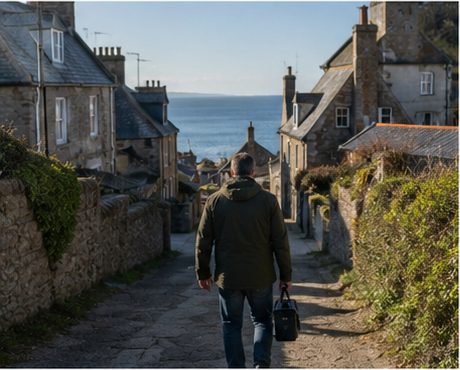
La boulangerie

Samedi, sept heures et demie. À l’hôtel, les clientes veulent des croissants. Alors, Véronique envoie Théo à la boulangerie.
À la boulangerie, il y a Inès. Elle a dix-neuf ans, comme Théo. Théo connaît Inès depuis l’école. Mais depuis cet été, devant elle, il ne sait plus parler.
Dans la boulangerie, deux dames attendent. Elles prennent leurs baguettes, elles disent bonjour à tout le monde, et elles savent déjà tout : qui arrive, qui part, qui pêche bien… et qui ne pêche rien.
Ici, les gens voient tout. Et ils disent tout.
Puis Lucien entre. Il a quatre-vingt-deux ans. C’est le grand-père d’Inès et le meilleur pêcheur du village. Dans son panier, il y a trois gros poissons.
Devant la boulangerie, deux pêcheurs du port regardent leurs paniers vides, puis le panier de Lucien. Ils font tout pour savoir où il pêche. Ils boivent des cafés avec lui, ils posent des questions. Mais Lucien ne dit jamais où.

Dans sa poche, Théo a une photo : la dernière page du carnet d’Émile. Une carte, une croix, et trois mots : « le rocher noir ».
Douze croissants
Inès : Salut, Théo !
Théo : Euh… Bonjour. Douze. Croissants. S’il vous plaît.
Inès : « S’il vous plaît » ? Depuis quand tu me dis « vous » ?
Théo : Pardon. S’il te plaît.
Inès : Alors, quoi de neuf à l’hôtel ?
Théo : Deux clientes. Elles viennent de Lyon. Elles prennent tout en photo. Même Gustave.
Inès : Et l’Anglais ? Il prend quelque chose, aujourd’hui ?
Théo : Non. Quand il arrive, les poissons partent.
Inès : Ha ! Ici, les gens savent tout.
(Lucien entre.)
Théo : Bonjour, monsieur Lucien ! Vous pêchez où, aujourd’hui ?
Lucien : Là-bas.
Théo : Là-bas… où ?
Lucien : Là-bas. Bonne journée.
(Lucien part.)
Inès : Mon grand-père, il dit jamais où. Même pas à moi.
Théo : Attends… Regarde cette photo. Le rocher noir, tu connais ?
Inès : Le rocher noir ? Les pêcheurs disent que c’est une légende.
Théo : Et ton grand-père ?
Inès : Mon grand-père… il sourit. C’est tout.
Hover any word for its sound and its English, or read the whole text in English first. Saturday, half past seven. At the hotel, the guests want croissants. So Véronique sends Théo to the bakery. At the bakery there is Inès. She is nineteen, like Théo. Théo has known Inès since school. But since this summer, in front of her, he can no longer speak. In the bakery two ladies are waiting. They take their baguettes, they say hello to everybody, and they already know everything: who is arriving, who is leaving, who fishes well… and who catches nothing. Here, people see everything. And they tell everything. Then Lucien comes in. He is eighty-two. He is Inès’s grandfather and the best fisherman in the village. In his basket there are three big fish. Outside the bakery, two fishermen from the harbour look at their empty baskets, then at Lucien’s basket. They do everything they can to find out where he fishes. They drink coffees with him, they ask questions. But Lucien never says where. In his pocket, Théo has a photo: the last page of Émile’s notebook. A map, a cross, and three words: "the black rock". TWELVE CROISSANTS. INÈS: Hi, Théo! THÉO: Um… Good morning. Twelve. Croissants. Please (using "vous"). INÈS: "S’il vous plaît"? Since when do you say "vous" to me? THÉO: Sorry. Please (using "tu"). INÈS: So, what’s new at the hotel? THÉO: Two guests. They come from Lyon. They take photos of everything. Even Gustave. INÈS: And the Englishman? Is he catching anything today? THÉO: No. When he arrives, the fish leave. INÈS: Ha! Here, people know everything. (Lucien comes in.) THÉO: Good morning, Monsieur Lucien! Where are you fishing today? LUCIEN: Over there. THÉO: Over there… where? LUCIEN: Over there. Have a nice day. (Lucien leaves.) INÈS: My grandfather never says where. Not even to me. THÉO: Wait… Look at this photo. The black rock, do you know it? INÈS: The black rock? The fishermen say it is a legend. THÉO: And your grandfather? INÈS: My grandfather… he smiles. That’s all.
Mots et expressions
30 mots
| Français | English |
|---|---|
| la boulangerie | the bakery |
| le croissant | the croissant |
| la baguette | the baguette, the French stick |
| une cliente, un client | a guest, a customer |
| envoyer | to send |
| depuis l’école | since school |
| depuis cet été | since this summer |
| ne… plus | no longer, not any more |
| devant elle | in front of her |
| une dame | a lady |
| attendre | to wait |
| dire bonjour | to say hello |
| les gens | people |
| entrer | to come in, to go in |
| le meilleur pêcheur | the best fisherman |
| gros, grosse | big |
| le port | the harbour |
| poser des questions | to ask questions |
| la poche | the pocket |
| une carte | a map |
| une croix | a cross |
| le rocher noir | the black rock |
| une légende | a legend |
| là-bas | over there |
| Quoi de neuf ? | What’s new? |
| Depuis quand ? | Since when? |
| Bonne journée ! | Have a nice day! |
| même pas à moi | not even to me |
| Attends ! | Wait! |
| Euh… | Um… |
Ils, elles: the letters you do not say
Grammaire 1
The -ent at the end of ils prennent is silent, always. What you hear is what comes just before it. In the singular the last consonant hides; in the plural it comes back.
| Infinitif | il / elle | ils / elles | you hear |
|---|---|---|---|
| partir | il part /paʁ/ | ils partent /paʁt/ | t |
| savoir | elle sait /sɛ/ | elles savent /sav/ | v |
| boire | il boit /bwa/ | ils boivent /bwav/ | v |
| mettre | il met /mɛ/ | ils mettent /mɛt/ | t |
| dire | il dit /di/ | ils disent /diz/ | z |
| connaître | elle connaît /kɔ.nɛ/ | elles connaissent /kɔ.nɛs/ | s |
| sortir | il sort /sɔʁ/ | ils sortent /sɔʁt/ | t |
| voir | il voit /vwa/ | ils voient /vwa/ | nothing |
That consonant is often the only way your ear can tell il from ils.
il part · ils partent · elle sait · elles savent · il boit · ils boivent
With -er verbs there is no such luck: il parle and ils parlent sound exactly the same, and so do il voit and ils voient. There, only the rest of the sentence tells you.
The boot: when the vowel changes too
Grammaire 2
Some verbs change more than a consonant. Write the six persons in two columns and draw a boot around je, tu, il and ils. Inside the boot the vowel is full; outside it, with nous and vous, it is weak.
| Infinitif | inside the boot | ils / elles | outside: nous, vous |
|---|---|---|---|
| venir | je viens, il vient | ils viennent | nous venons, vous venez |
| prendre | je prends, il prend | ils prennent | nous prenons, vous prenez |
| vouloir | je veux, il veut | ils veulent | nous voulons, vous voulez |
| pouvoir | je peux, il peut | ils peuvent | nous pouvons, vous pouvez |
| boire | je bois, il boit | ils boivent | nous buvons, vous buvez |
Leur, leurs
Grammaire 3
Their. Like notre and nos, it changes for number only, never for gender.
| one thing | several things |
|---|---|
| leur panier | leurs paniers |
| leur boulangerie | leurs baguettes |
| leur hôtel | leurs amis |
How it really comes out
Il dit jamais où.
Two things happen in Inès’s sentence Mon grand-père, il dit jamais où.
First, she names the person and then repeats him as il. Spoken French loves to announce its subject before the verb: Mon grand-père, il… · Les gens, ils…
Second, the ne has gone: il dit jamais means il ne dit jamais. In conversation French drops ne most of the time. Recognise it when you hear it; keep ne when you write.
And a social note: Théo and Inès are the same age and have known each other for years, so tu is the only natural choice. Vous between friends sounds cold, or, as here, just very strange.
Les expressions du texte · listen and repeat
Twelve sentences from the bakery. Tap a card to turn it over, the speaker to hear it, the star to keep it in your word bank.
- Les clientes veulent des croissants. /le kli.jɑ̃t vœl de kʁwa.sɑ̃/ The guests want croissants.
- Théo connaît Inès depuis l’école. /te.o kɔ.nɛ i.nɛs də.pɥi le.kɔl/ Théo has known Inès since school.
- Devant elle, il ne sait plus parler. /də.vɑ̃ ɛl il nə sɛ ply paʁ.le/ In front of her, he can no longer speak.
- Elles prennent leurs baguettes. /ɛl pʁɛn lœʁ ba.ɡɛt/ They take their baguettes.
- Ici, les gens savent tout. /i.si le ʒɑ̃ sav tu/ Here, people know everything.
- Ils voient tout, et ils disent tout. /il vwa tu e il diz tu/ They see everything, and they tell everything.
- Ils font tout pour savoir. /il fɔ̃ tu puʁ sa.vwaʁ/ They do everything they can to find out.
- Elles viennent de Lyon. /ɛl vjɛn də ljɔ̃/ They come from Lyon.
- Quand il arrive, les poissons partent. /kɑ̃.ti.la.ʁiv le pwa.sɔ̃ paʁt/ When he arrives, the fish leave.
- Depuis quand tu me dis « vous » ? /də.pɥi kɑ̃ ty mə di vu/ Since when do you say “vous” to me?
- Quoi de neuf à l’hôtel ? /kwa də nœf a lo.tɛl/ What’s new at the hotel?
- Mon grand-père, il dit jamais où. /mɔ̃ ɡʁɑ̃.pɛʁ il di ʒa.mɛ u/ My grandfather never says where.
Écoutez : un ou plusieurs ?
Press play and listen for the consonant. One person, or more than one? The sentence is only in the sound, so do not look for it on the page.
Quelle forme ?
Everybody in the village, in the plural. One verb per gap.
Un, puis plusieurs
Write the same sentence for more than one person. Think of the boot, and of the four verbs in -ont.
Son, sa ou leur ?
First ask who owns it, one person or several. Then count the things.
Tu ou vous ?
Who is talking to whom? A friend, a relative, an older man, two guests.
Vrai ou faux ?
Read the text again and decide.
Qui parle ?
Three voices in the bakery. Who says each line?
Et chez vous ?
Think of the people around you and finish each sentence out loud with ils or elles. Then click the card for one possible answer : yours will be different.
In pairs: one reads the beginning, the other finishes it, then swap.
Production écrite
Use six different verbs in the ils / elles form, leur or leurs twice, and one sentence the way it is really said: Mes voisins, ils…
Plan de l’épisode (нотатки для викладача, 60 хв)
| Час | Етап | Що робимо |
|---|---|---|
| 5 хв | Lead-in | Питання групі: Dans votre ville, les gens savent tout ? Короткі відповіді з ils. Нагадуємо, хто такий Émile і що знайшов Théo. |
| 7 хв | Reading for gist | Читають текст і діалог. Одне запитання: Qui est Lucien ? Далі Exercice 6 (vrai / faux). |
| 8 хв | Ils, elles | Граматика 1: закінчення -ent мовчить, приголосна повертається. Вимовляємо пари вголос. Exercice 1 на слух: кнопку натискає викладач, група показує пальцями «один» чи «багато». |
| 6 хв | The boot | Малюємо «чобіт» на дошці для venir і prendre. Exercice 2. |
| 7 хв | Drill | Exercice 3 письмово, самоперевірка. Окремо: чотири дієслова на -ont. |
| 5 хв | Leur, leurs | Граматика 3 і Exercice 4. Правило: спершу хто власник, потім скільки речей. |
| 5 хв | Tu / vous | Exercice 5. Обговорюємо, чому Théo каже vous Lucien, а Inès каже tu своєму дідусеві. |
| 13 хв | Speaking | Рольова гра «À la boulangerie» у трійках: Inès, Théo (не може говорити!) і Lucien (одне слово). Потім кожен розповідає групі одну «плітку» з ils / elles про інших героїв. |
| 4 хв | Wrap-up | Exercice 7 на слух. Домашнє: Production écrite і Exercice 8. |