Nous sommes deux
Friday evening, two suitcases, and a box nobody has opened since 1952.
A new part of the story begins, Une semaine au Poisson rouge. Marc’s Friday is not over yet. At seven in the evening two women from Lyon walk into the hotel with their suitcases, and one of them is Sophie from Épisode 1. By the end of the evening, somebody has opened a box that has stayed shut since 1952.
Les personnages
3 nouveaux
Sophie, l’agente immobilière de Lyon (Épisode 1), on holiday until Wednesday. To a hotel she says nous; to her friend, a second later, she says on.
Camille, her colleague from the office. She photographs everything and asks as many questions as Théo, which nobody thought possible.
Gustave, the goldfish in the tank by the door. He never leaves. Remember him: he knows more than he looks.
Texte
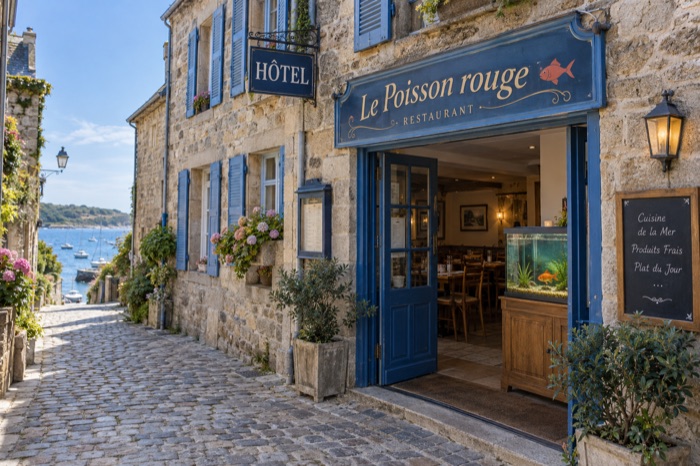
Le week-end de Sophie
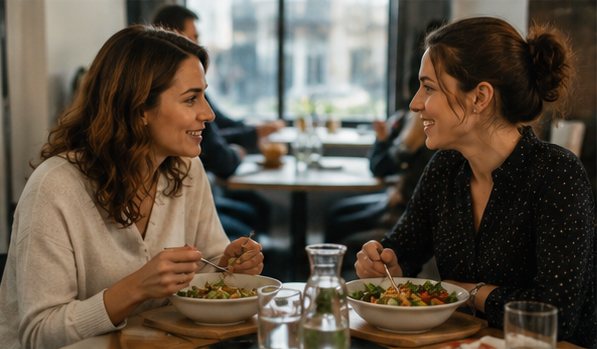
Salut, c’est encore Sophie ! Ce vendredi, Camille et moi, nous finissons tôt. Nous partons en vacances jusqu’à mercredi. Nous prenons la voiture à midi, et à sept heures du soir, nous sommes au bord de la mer.
Nous ne connaissons pas le village. Nous voulons juste du calme, la mer et du bon poisson.
L’hôtel s’appelle « Le Poisson rouge ». À l’entrée, il y a un aquarium avec un poisson rouge. Camille prend tout en photo : la mer, les bateaux, l’aquarium, et même le poisson.
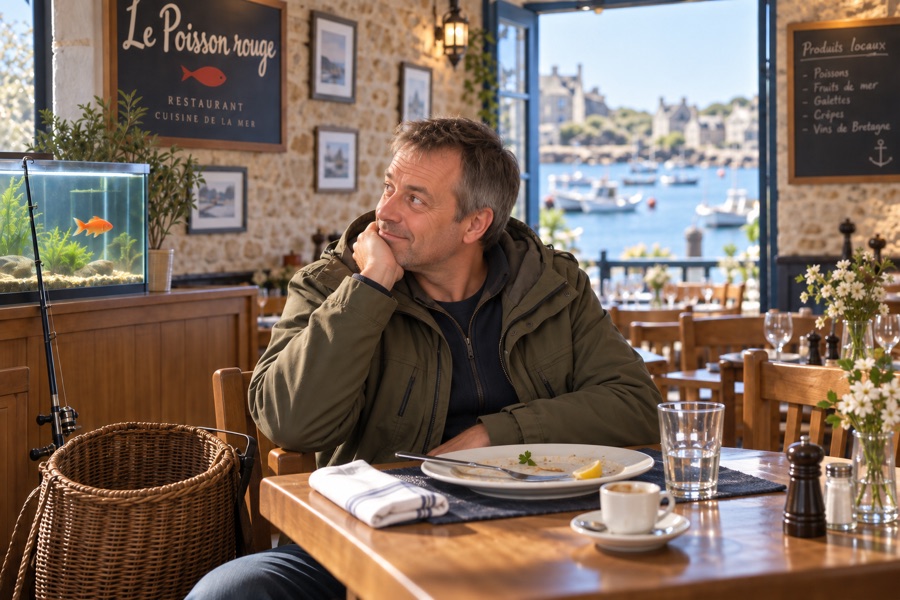
À une table, près de la fenêtre, un homme boit un café. Il a l’air fatigué, et son panier est vide. Véronique, la patronne, apporte un deuxième café, sans sucre. Elle ne demande rien : elle sait.
Ici, nous faisons connaissance avec tout le monde en cinq minutes.

Théo, le neveu de Véronique, monte nos valises dans notre chambre, sous le toit. Là-haut, derrière une vieille porte, il y a une boîte. Nous voyons la boîte avec lui. Dans la boîte, il y a un vieux carnet. Sur le carnet, il y a quelques mots et une date : « Carnet de pêche. Émile. 1952. »
À la réception
Théo : Bonsoir ! Vous êtes combien ?
Sophie : Nous sommes deux. Nous avons une réservation au nom de Martin.
Théo : Martin… Ah oui. Deux personnes, cinq nuits. Vous venez d’où ?
Camille : Nous venons de Lyon. Et nous voulons une chambre avec vue sur la mer !
Théo : Vous avez de la chance : c’est notre plus belle chambre.
Véronique : Théo ! Tu dis « vous » ? Bravo !
Théo : Ben… elles sont deux.
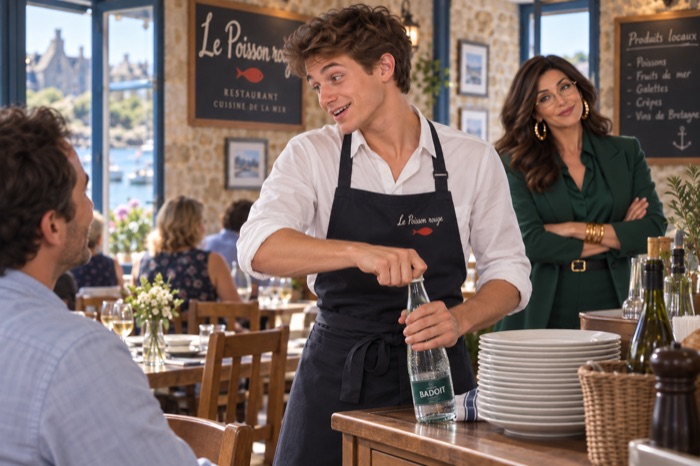
Camille : Et le poisson rouge, il s’appelle comment ?
Théo : Gustave. Il ne part jamais. Comme ma tante.
Véronique : Théo…
Camille : Sophie, on dîne ici, ce soir ?
Sophie : Oui ! Nous prenons le plat du jour, s’il vous plaît.
Théo : Du poisson. Mais pas le poisson de monsieur, là-bas. Lui, il pêche. Enfin… il essaie.
Marc : Bonsoir.
Sous le toit
Théo : Tante Véro ! Viens voir ! Il y a une boîte sous le toit !
Véronique : Montre… « Émile, 1952 ». Théo… c’est le carnet de mon grand-père.
Hover any word for its sound and its English, or read the whole text in English first. Hi, it’s Sophie again! This Friday, Camille and I finish early. We are going on holiday until Wednesday. We take the car at midday, and at seven in the evening we are by the sea. We do not know the village. We just want some peace and quiet, the sea and some good fish. The hotel is called "Le Poisson rouge". At the entrance there is a fish tank with a goldfish. Camille takes photos of everything: the sea, the boats, the tank, and even the fish. At a table by the window, a man is drinking a coffee. He looks tired, and his basket is empty. Véronique, the owner, brings him a second coffee, without sugar. She does not ask anything: she knows. Here, we get to know everybody in five minutes. Théo, Véronique’s nephew, carries our suitcases up to our room, under the roof. Up there, behind an old door, there is a box. We see the box with him. In the box there is an old notebook. On the notebook there are a few words and a date: "Fishing notebook. Émile. 1952." AT THE FRONT DESK. THÉO: Good evening! How many of you are there? SOPHIE: There are two of us. We have a booking under the name Martin. THÉO: Martin… Ah yes. Two people, five nights. Where are you from? CAMILLE: We are from Lyon. And we would like a room with a sea view! THÉO: You are lucky: it is our best room. VÉRONIQUE: Théo! You are saying "vous"? Well done! THÉO: Well… there are two of them. CAMILLE: And the goldfish, what is he called? THÉO: Gustave. He never leaves. Like my aunt. VÉRONIQUE: Théo… CAMILLE: Sophie, shall we have dinner here tonight? SOPHIE: Yes! We will have the dish of the day, please. THÉO: Fish. But not the gentleman’s fish, over there. Him, he fishes. Well… he tries. MARC: Good evening. UNDER THE ROOF. THÉO: Aunt Véro! Come and look! There is a box under the roof! VÉRONIQUE: Show me… "Émile, 1952". Théo… this is my grandfather’s notebook.
Mots et expressions
30 mots
| Français | English |
|---|---|
| finir tôt | to finish early |
| partir en vacances | to go on holiday |
| jusqu’à mercredi | until Wednesday |
| prendre la voiture | to take the car |
| au bord de la mer | by the sea |
| le calme | peace and quiet |
| prendre en photo | to take a photo of |
| le bateau | the boat |
| avoir l’air fatigué | to look tired |
| sans sucre | without sugar |
| ne… rien | nothing |
| faire connaissance (avec) | to get to know (somebody) |
| monter les valises | to carry the suitcases up |
| la valise | the suitcase |
| sous le toit | under the roof, in the attic |
| là-haut | up there |
| la boîte | the box |
| le carnet | the notebook |
| le carnet de pêche | the fishing notebook, the fishing log |
| le grand-père | the grandfather |
| la tante | the aunt |
| la réception | the front desk |
| une réservation | a booking |
| au nom de | under the name of |
| une nuit | a night |
| avec vue sur la mer | with a sea view |
| avoir de la chance | to be lucky |
| dîner | to have dinner |
| Vous êtes combien ? | How many of you are there? |
| Viens voir ! | Come and look! |
Nous: the form you already own
Grammaire 1
In Épisode 4 you met vous prenez, vous venez, vous voulez. Nous is built on exactly the same stem, so you already know it. Take the vous form, swap -ez for -ons, and you are done.
| Infinitif | vous (Épisode 4) | nous |
|---|---|---|
| prendre | vous prenez | nous prenons |
| venir | vous venez | nous venons |
| vouloir | vous voulez | nous voulons |
| pouvoir | vous pouvez | nous pouvons |
| savoir | vous savez | nous savons |
| connaître | vous connaissez | nous connaissons |
| voir | vous voyez | nous voyons |
| partir | vous partez | nous partons |
| finir | vous finissez | nous finissons |
| avoir | vous avez | nous avons |
| être | vous êtes | nous sommes |
| faire | vous faites | nous faisons |
| dire | vous dites | nous disons |
One warning for the ear.
nous faisons /nu fə.zɔ̃/
The ai of faisons is said as a light, short e, as in le. Not “fay-zon”.
Notre, nos
Grammaire 2
Something that belongs to us. Épisode 5 needed three words for my (mon, ma, mes). Our needs only two, because masculine and feminine make no difference here: only one or several.
| one thing | several things |
|---|---|
| notre chambre | nos valises |
| notre hôtel | nos photos |
| notre village | nos amis |
notre /nɔtʁ/ · nos /no/ · nos amis /no.za.mi/
Before a vowel the s of nos wakes up and joins the next word as a z. And you have met the pair votre, vos already, in Épisode 5: it works the same way.
How it really comes out
On est deux.
At the desk Sophie says nous sommes deux, because she is talking to a hotel. To Camille, a second later, she would say on est deux, and Camille herself asks on dîne ici, ce soir ?
In everyday French on replaces nous almost every time, and the verb takes the il form: on prend, on vient, on fait, on est deux.
Learn nous to read and to write. Expect on in every conversation you hear.
Les expressions du texte · listen and repeat
Twelve sentences from Friday evening. Tap a card to turn it over, the speaker to hear it, the star to keep it in your word bank.
- Nous sommes deux. /nu sɔm dø/ There are two of us.
- Nous avons une réservation. /nu.za.vɔ̃ yn ʁe.zɛʁ.va.sjɔ̃/ We have a booking.
- Nous venons de Lyon. /nu və.nɔ̃ də ljɔ̃/ We are from Lyon.
- Nous voulons une chambre avec vue sur la mer. /nu vu.lɔ̃ yn ʃɑ̃bʁ a.vɛk vy syʁ la mɛʁ/ We would like a room with a sea view.
- Nous prenons le plat du jour. /nu pʁə.nɔ̃ lə pla dy ʒuʁ/ We will have the dish of the day.
- Nous partons en vacances. /nu paʁ.tɔ̃ ɑ̃ va.kɑ̃s/ We are going on holiday.
- Nous ne connaissons pas le village. /nu nə kɔ.nɛ.sɔ̃ pa lə vi.laʒ/ We do not know the village.
- Nous faisons connaissance avec tout le monde. /nu fə.zɔ̃ kɔ.nɛ.sɑ̃s a.vɛk tu lə mɔ̃d/ We get to know everybody.
- C’est notre plus belle chambre. /sɛ nɔtʁ ply bɛl ʃɑ̃bʁ/ It is our best room.
- Vous venez d’où ? /vu və.ne du/ Where are you from?
- On dîne ici, ce soir ? /ɔ̃ din i.si sə swaʁ/ Shall we have dinner here tonight?
- Il ne part jamais. /il nə paʁ ʒa.mɛ/ He never leaves.
Quelle forme ?
Sophie is speaking for two. One verb per gap, always in the nous form.
Vous… Nous…
Théo asks with vous, Sophie answers with nous. Swap -ez for -ons, and watch the three rebels.
Notre ou nos ?
Sophie and Camille are unpacking. One thing or several?
Regardez la photo et répondez
The picture and the text together have every answer.
Sophie et CamillePrès de la fenêtreSous le toitDites-le avec « on »
The same sentence, the way Camille would say it. With on, the verb takes the il form.
Vrai ou faux ?
Read the text again and decide.
Qui parle ?
Four voices at the front desk. Who says each line?
Et vous ?
Think of the people you live, work or travel with, and finish each sentence out loud with nous. Then click the card for one possible answer : yours will be different.
In pairs: one reads the beginning, the other finishes it, then swap.
Production écrite
Use nous at least four times with four different verbs, notre or nos twice, and write one sentence the way you would say it out loud, with on: Le soir, on dîne au bord de la mer.
Plan de l’épisode (нотатки для викладача, 60 хв)
| Час | Етап | Що робимо |
|---|---|---|
| 5 хв | Lead-in | Викладач питає всю групу разом: Vous êtes combien ? Vous venez d’où ? Група відповідає хором: Nous sommes huit. Nous venons de Kyiv. Так nous з'являється ще до тексту. |
| 7 хв | Reading for gist | Читають текст і обидва діалоги. Одне запитання: Qu’est-ce qu’il y a dans la boîte ? Далі Exercice 6 (vrai / faux). |
| 8 хв | Nous | Таблиця vous → nous. Показуємо, що це ті самі основи з Épisode 4, лише -ez стає -ons; окремо три винятки і вимова faisons. Exercice 1. |
| 7 хв | Drill | Exercice 2 письмово, самоперевірка кнопкою. Потім усно в парах: один питає з vous, другий відповідає з nous. |
| 5 хв | Notre, nos | Exercice 3. Швидко вголос: викладач показує речі в класі, група каже notre classe, nos livres, notre prof. |
| 6 хв | On = nous | Блок «How it really comes out», далі Exercice 5. Наголос: на вулиці почують саме on, а писати краще з nous. |
| 8 хв | Photos | Exercice 4 у парах: один читає питання, другий відповідає повним реченням. |
| 10 хв | Speaking | Рольова гра «À la réception»: пара гостей (nous) і адміністратор (vous). Умова: п'ять різних дієслів у формі nous і одне речення з notre. |
| 4 хв | Wrap-up | Exercice 7 на слух: викладач читає репліки, група каже, хто це. Домашнє: Production écrite і Exercice 8. |