Il est où, mon téléphone ?
The bill arrives, the phone does not, and the whole table turns into a grammar exercise.
Épisode 4 gave you tu, il, elle and the polite vous. This lesson leaves the verb alone for once and works on the two things that surround it: where something is, and whose it is. You also get the four sentences you need at the end of every meal in France, from l’addition, s’il vous plaît to je peux payer par carte ?
Texte
L’addition, s’il vous plaît !
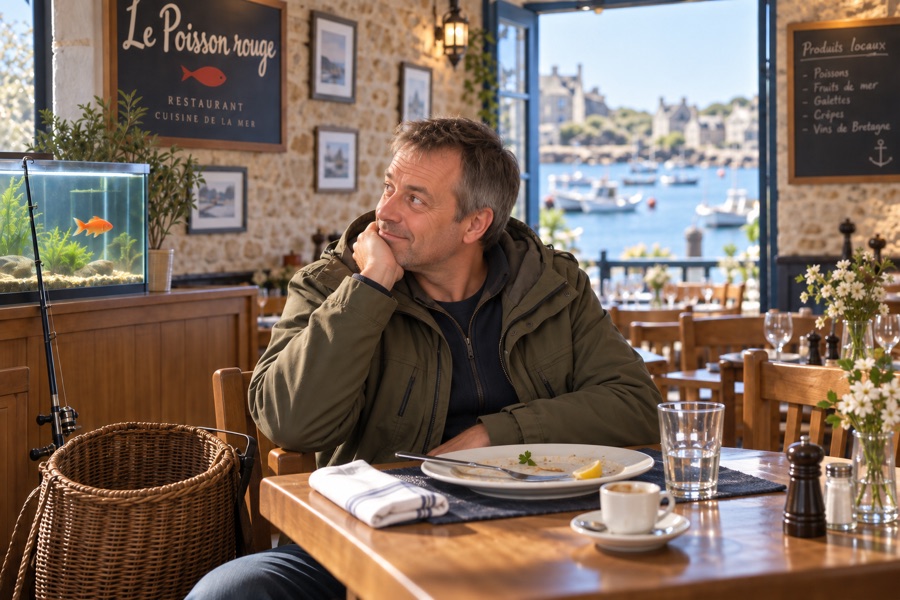
Marc finit son déjeuner. Cette fois, il est content : le poisson est bon, et le café aussi. Il regarde l’aquarium près de la porte.
Marc est en face de la fenêtre. Sur la table, il y a une assiette vide, un verre et une tasse de café. Sa canne à pêche est derrière la chaise, et son panier est à côté de la table. À gauche, l’aquarium est sous le tableau « Le Poisson rouge ». Le poisson rouge, lui, est toujours dans son aquarium.
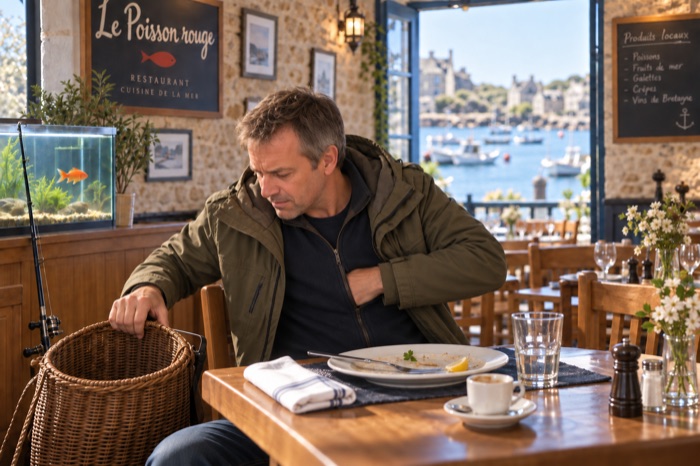
Marc veut payer, mais il ne trouve pas son téléphone. Il regarde dans ses poches, puis dans son panier. Rien. Il regarde sous la table, sur la chaise, derrière le panier, entre les serviettes. Toujours rien.
« Ce n’est pas ma journée… », dit-il.
Théo voit le téléphone sous la serviette. Il sourit. Véronique le regarde. Elle sait : Théo parle toujours trop !
Véronique arrive avec la machine à carte. Théo est déjà devant la table, avec un grand sourire.
Un téléphone bien caché
Marc : L’addition, s’il vous plaît. Ça fait combien ?
Véronique : Ça fait dix-huit euros. Le café, c’est offert !
Marc : Merci ! Je peux payer par carte ?
Véronique : Bien sûr.
Marc : Ah… Il est où, mon téléphone ?
Théo : Sous votre serviette !
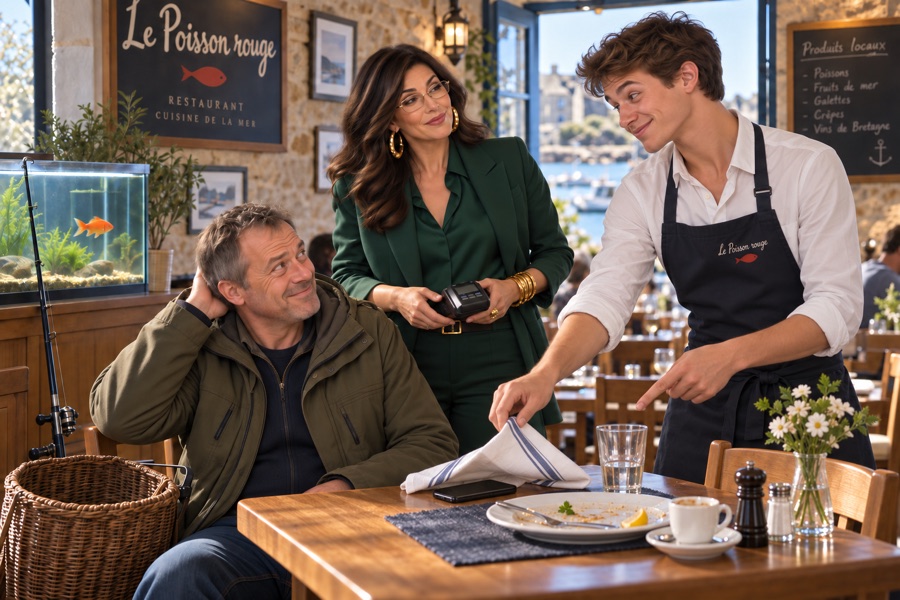
Marc : Ah oui ! Merci. J’ai la tête ailleurs.
Théo : À la pêche ?
Véronique : Théo, ça suffit.
Théo : Ben quoi ? Je pose juste une question !
Marc : Pas de souci. Il a raison !
Hover any word for its sound and its English, or read the whole text in English first. Marc finishes his lunch. This time he is happy: the fish is good, and so is the coffee. He looks at the fish tank near the door. Marc is opposite the window. On the table there is an empty plate, a glass and a cup of coffee. His fishing rod is behind the chair, and his basket is next to the table. On the left, the tank is under the sign "Le Poisson rouge". The goldfish, for its part, is still in its tank. Marc wants to pay, but he cannot find his phone. He looks in his pockets, then in his basket. Nothing. He looks under the table, on the chair, behind the basket, between the napkins. Still nothing. "This is not my day…" he says. Théo sees the phone under the napkin. He smiles. Véronique looks at him. She knows: Théo always talks too much! Véronique comes over with the card machine. Théo is already in front of the table, with a big smile. MARC: The bill, please. How much is it? VÉRONIQUE: That comes to eighteen euros. The coffee is on us! MARC: Thank you! Can I pay by card? VÉRONIQUE: Of course. MARC: Ah… Where is my phone? THÉO: Under your napkin! MARC: Ah yes! Thank you. My head is elsewhere. THÉO: Out fishing? VÉRONIQUE: Théo, that is enough. THÉO: What? I am only asking a question! MARC: No problem. He is right!
Mots et grammaire
30 mots · 4 tableaux
Mots et expressions utiles
| Français | English |
|---|---|
| l’addition | the bill |
| Ça fait combien ? | how much is it? |
| payer | to pay |
| payer par carte | to pay by card |
| payer en espèces | to pay in cash |
| c’est offert | it is on the house |
| bien sûr | of course |
| l’euro | the euro |
| trouver | to find |
| chercher | to look for |
| sourire | to smile; a smile |
| poser une question | to ask a question |
| avoir raison | to be right |
| avoir la tête ailleurs | to have one’s head elsewhere |
| ça suffit | that is enough |
| pas de souci | no problem |
| ben quoi ? | what? (spoken, a little cheeky) |
| la serviette | the napkin (also: the towel) |
| la poche | the pocket |
| la chaise | the chair |
| le verre | the glass |
| la tasse | the cup |
| la fenêtre | the window |
| le tableau | the picture, the sign, the board |
| la machine à carte | the card machine |
| cette fois | this time |
| content, contente | happy, pleased |
| à gauche / à droite | on the left / on the right |
| toujours | always; still |
| rien | nothing |
Les prépositions de lieu
Nine words, and every one of them is in the text above.
| Préposition | English | Dans le texte |
|---|---|---|
| dans | in, inside | Il regarde dans ses poches. |
| sur | on | Sur la table, il y a une assiette vide. |
| sous | under | Le téléphone est sous la serviette. |
| devant | in front of | Théo est devant la table. |
| derrière | behind | Sa canne à pêche est derrière la chaise. |
| à côté de | next to | Son panier est à côté de la table. |
| près de | near | L’aquarium est près de la porte. |
| en face de | opposite | Marc est en face de la fenêtre. |
| entre | between | Il regarde entre les serviettes. |
à côté du panier (de + le), not à côté de le panier.
près de la porte and en face de l’aquarium stay as they are.
en face des bateaux (de + les).
Two of them sound almost the same and mean opposite things.
sur /syʁ/ · sous /su/
The first has the tight u of tu, the second the round ou of vous. On the table or under it: the whole difference is that one vowel.
Mon, ma, mes : à qui c’est ?
French does not ask who the owner is. It asks what the thing is.
| + masculin | + féminin | + pluriel | |
|---|---|---|---|
| je | mon panier | ma journée | mes poches |
| tu | ton café | ta table | tes questions |
| il / elle | son téléphone | sa canne | ses poches |
| vous | votre panier | votre serviette | vos questions |
À la fin du repas
Four sentences, and the meal is paid for anywhere in France.
| Vous dites | On vous répond |
|---|---|
| L’addition, s’il vous plaît. | Oui, tout de suite. |
| Ça fait combien ? | Ça fait dix-huit euros. |
| Je peux payer par carte ? | Bien sûr. |
| Et le café ? | Le café, c’est offert ! |
How the question really comes out. The book says Où est mon téléphone ? Marc says Il est où, mon téléphone ?
Spoken French likes to put the question word at the end and to name the thing afterwards: Ça fait combien ?, Tu vas où ?, C’est qui ? Both are correct. The second is what you will hear.
Les expressions du texte — listen and repeat
Twelve sentences from the end of the meal. Tap a card to turn it over, the speaker to hear it, the star to keep it in your word bank.
- Marc finit son déjeuner. /maʁk fi.ni sɔ̃ de.ʒø.ne/ Marc finishes his lunch.
- Le poisson est bon, et le café aussi. /lə pwa.sɔ̃ ɛ bɔ̃ e lə ka.fe o.si/ The fish is good, and so is the coffee.
- Sa canne à pêche est derrière la chaise. /sa kan a pɛʃ ɛ dɛ.ʁjɛʁ la ʃɛz/ His fishing rod is behind the chair.
- Son panier est à côté de la table. /sɔ̃ pa.nje ɛ.ta ko.te də la tabl/ His basket is next to the table.
- Il ne trouve pas son téléphone. /il nə tʁuv pa sɔ̃ te.le.fɔn/ He cannot find his phone.
- Il regarde dans ses poches. /il ʁə.ɡaʁd dɑ̃ se pɔʃ/ He looks in his pockets.
- Ce n’est pas ma journée. /sə nɛ pa ma ʒuʁ.ne/ This is not my day.
- L’addition, s’il vous plaît. /la.di.sjɔ̃ sil vu plɛ/ The bill, please.
- Ça fait combien ? /sa fɛ kɔ̃.bjɛ̃/ How much is it?
- Je peux payer par carte ? /ʒə pø pe.je paʁ kaʁt/ Can I pay by card?
- Il est où, mon téléphone ? /i.lɛ u mɔ̃ te.le.fɔn/ Where is my phone?
- Sous votre serviette ! /su vɔtʁ sɛʁ.vjɛt/ Under your napkin!
Où est-ce ?
One preposition per gap. Picture the table before you choose.
Complétez le texte
The end of Marc’s lunch, one word per gap: a preposition or a possessive.
Regardez la photo et répondez
Everything you need is in the picture. Answer with the preposition that fits.
Après le déjeunerRien !L’additionMon, ma ou mes ?
Marc is speaking. Look at the noun, not at Marc: it is the noun that decides.
Vrai ou faux ?
Read the text again and decide.
Qui parle ?
Three voices at one table. Who says each line?
Et vous ?
Look around the room you are sitting in and finish each sentence out loud. Then click the card for one possible answer — yours will be different.
In pairs: one reads the beginning, the other finishes it, then swap.
Production écrite
Use at least five different prepositions, three possessives (mon, ma, mes), and one sentence that says where something is not: Mon téléphone n’est pas sur la table.
Plan de l’épisode (нотатки для викладача, 60 хв)
| Час | Етап | Що робимо |
|---|---|---|
| 5 хв | Lead-in | Викладач ховає свій телефон у класі і питає: Il est où, mon téléphone ? Група шукає і пробує сказати де. Тут одразу видно, яких прийменників бракує. |
| 7 хв | Reading for gist | Читають текст і діалог один раз. Одне запитання: Qui trouve le téléphone ? Далі Exercice 5 (vrai / faux). |
| 9 хв | Prépositions | Таблиця дев'яти прийменників, потім Exercice 1. Окремо промовляємо пару sur / sous: різниця тільки в голосному, а зміст протилежний. |
| 6 хв | de + le | Чому à côté du panier, а не à côté de le panier. Швидка усна вправа: викладач називає предмет у класі, група каже, що поруч із ним. |
| 8 хв | Possessifs | Таблиця mon / ma / mes і головна пастка: рід визначає річ, а не власник. Exercice 4, разом із випадком mon addition. |
| 8 хв | Photos | Exercice 3 у парах: один ставить питання до фото, другий відповідає повним реченням із прийменником, потім міняються. |
| 7 хв | Drill | Exercice 2 письмово, самоперевірка кнопкою. Далі Exercice 6 на слух: викладач читає репліки, група каже, хто це. |
| 7 хв | Speaking | Рольова гра «l’addition» у трійках: клієнт, господиня, офіціант. Обов'язково Ça fait combien ? і Je peux payer par carte ? Хто хоче, ховає щось на столі і змушує інших це знайти. |
| 3 хв | Wrap-up | Кожен називає одну річ у класі і каже, де вона. Домашнє: Production écrite. |