Je sais, tu sais, elle sait
Lunch at Le Poisson rouge, where the whole village already knows what you did not catch.
Marc left Épisode 3 walking to the village with an empty basket and a sentence about tomorrow. It is now half past twelve, and he is about to meet two people who already know how his morning went. On the way you will pick up six more verbs of the third group, and the one piece of French etiquette that no grammar book can teach you politely enough: when to say tu and when to say vous.
Les personnages
3 personnes
Véronique, la patronne de l’hôtel-restaurant Le Poisson rouge. Elle vient de Paris, elle habite au village de ses parents, et elle ouvre sa salle à midi depuis vingt ans. Toujours en vert et en or. She says vous to everybody, including people she has known since they were five.
Théo, dix-neuf ans, her nephew, working the dining room for the summer. He says tu to everybody, including people he met four seconds ago. He knows every piece of news in the village and keeps none of it.
Marc, the fisherman from Épisode 3, arriving with an empty basket and no intention of mentioning it.
Texte

Le Poisson rouge

Il est midi et demi. Marc arrive au village avec un panier vide. Il ne veut pas parler de sa matinée.

Au bout de la rue, il y a un petit hôtel avec un restaurant. Le restaurant s’appelle « Le Poisson rouge ». À l’entrée, il y a un aquarium, et dans l’aquarium, il y a un poisson rouge. C’est le seul poisson du village qui ne part jamais.

Véronique ouvre le restaurant à midi. Elle porte toujours du vert et de l’or. Elle vient de Paris, mais elle connaît tout le monde ici. Elle sait qui pêche bien et qui rentre avec un panier vide.
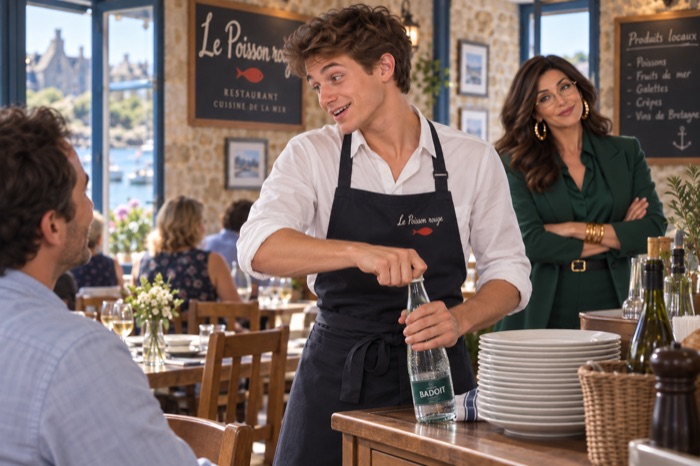
Théo a dix-neuf ans. C’est le neveu de Véronique. L’été, il travaille dans la salle. Il sort les assiettes, il ouvre les bouteilles et il parle beaucoup. Il sait tout, et il dit tout.
À table — Véronique, Théo et Marc
Véronique : Bonjour, monsieur. C’est pour déjeuner ?
Marc : Oui. Vous avez quoi, aujourd’hui ?
Véronique : Du poisson.
Théo : Tu viens de la pêche ?
Véronique : Théo ! On dit « vous ».
Théo : Pardon ! Vous prenez du poisson ?
Marc : Oui, je prends le poisson.
Théo : Bonne idée ! À la pêche, aujourd’hui, vous ne prenez rien !
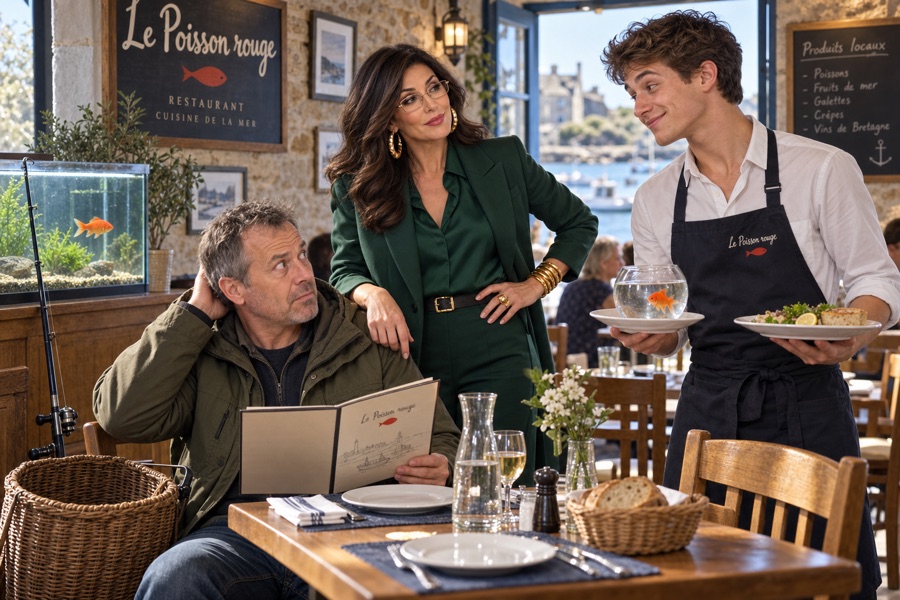
Marc : … Comment vous savez ça ?
Théo : Moi, je sais tout !
Véronique : Bon… Je vous offre un café, monsieur !
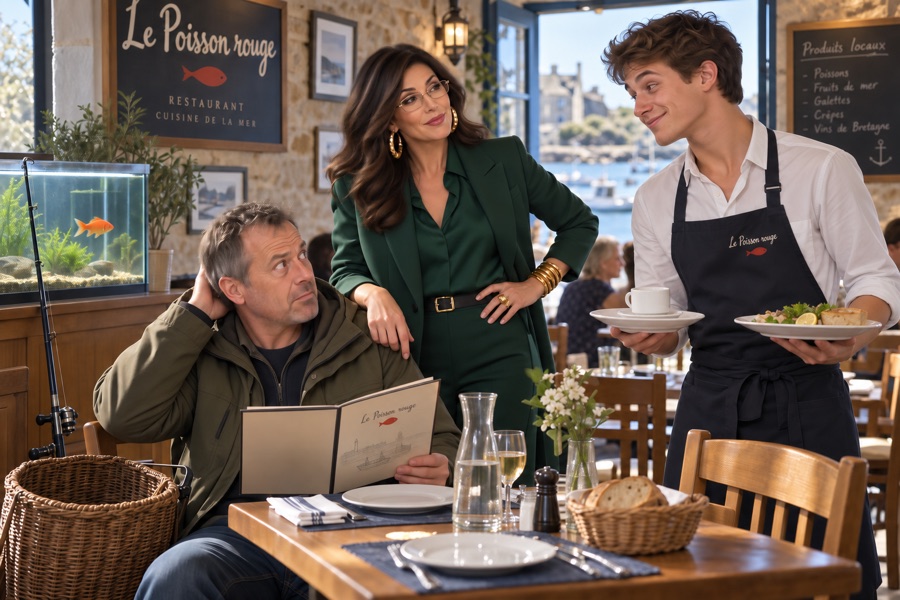
Hover any word for its sound and its English, or read the whole text in English first. It is half past twelve. Marc arrives in the village with an empty basket. He does not want to talk about his morning. At the end of the street there is a small hotel with a restaurant. The restaurant is called "Le Poisson rouge". At the entrance there is a fish tank, and in the tank there is a goldfish. It is the only fish in the village that never leaves. Véronique opens the restaurant at midday. She always wears green and gold. She comes from Paris, but she knows everybody here. She knows who fishes well and who comes home with an empty basket. Théo is nineteen. He is Véronique’s nephew. In the summer he works in the dining room. He takes out the plates, he opens the bottles and he talks a lot. He knows everything, and he tells everything. VÉRONIQUE: Good afternoon, sir. Are you here for lunch? MARC: Yes. What have you got today? VÉRONIQUE: Fish. THÉO: Are you back from the fishing? VÉRONIQUE: Théo! We say "vous". THÉO: Sorry! Are you having fish? MARC: Yes, I will have the fish. THÉO: Good idea! Out fishing today, you catch nothing! MARC: … How do you know that? THÉO: I know everything! VÉRONIQUE: Right… The coffee is on me, sir!
Mots et grammaire
30 mots · 6 tableaux
Mots et expressions utiles
| Français | English |
|---|---|
| savoir | to know (a fact, how to do something) |
| connaître | to know (a person, a place) |
| ouvrir | to open |
| fermer | to close |
| offrir | to offer, to give as a present |
| servir | to serve |
| sortir | to go out, to take something out |
| déjeuner | to have lunch |
| la pêche | fishing; venir de la pêche, to be back from fishing |
| la patronne | the owner, the boss (of a café, a shop) |
| le neveu | the nephew |
| la salle | the dining room |
| l’assiette | the plate |
| la bouteille | the bottle |
| le plat du jour | the dish of the day |
| bonne idée ! | good idea! |
| l’entrée | the entrance (also: the starter) |
| l’aquarium | the fish tank |
| un poisson rouge | a goldfish |
| le panier | the basket |
| vide | empty |
| le seul, la seule | the only one |
| tout le monde | everybody |
| personne ne… | nobody |
| ne… rien | nothing |
| ne… jamais | never |
| pardon ! | sorry! (also: excuse me) |
| s’il vous plaît | please (to someone you call vous) |
| au bout de la rue | at the end of the street |
| midi et demi | half past twelve |
Les trois personnes du singulier
Take the ten verbs you already have from Épisode 3 and look at what happens when you move from je to tu and to il / elle. Almost nothing happens.
| Infinitif | je | tu | il / elle |
|---|---|---|---|
| prendre | je prends | tu prends | il prend |
| venir | je viens | tu viens | elle vient |
| partir | je pars | tu pars | il part |
| faire | je fais | tu fais | il fait |
| voir | je vois | tu vois | elle voit |
| vouloir | je veux | tu veux | il veut |
| pouvoir | je peux | tu peux | elle peut |
| mettre | je mets | tu mets | il met |
| boire | je bois | tu bois | elle boit |
| dire | je dis | tu dis | il dit |
je and tu are the same word, letter for letter. For il / elle, take off the -s and put a -t: il fait, elle voit, il part.
Two verbs look as if they forgot the -t: il prend and il met. They did not. A stem that already ends in d or t adds nothing.
Now the part that makes French easy to hear and hard to spell. In the singular, all three forms sound exactly the same:
je sais, tu sais, elle sait /sɛ/ · je prends, tu prends, il prend /pʁɑ̃/ · je veux, tu veux, elle veut /vø/
You hear one form and you write three. The pronoun does all the work, which is why French never drops it.
Six verbes nouveaux
All six are in the text. Four of them behave exactly like the verbs in the table above, and two of them play a small trick.
| Infinitif | je | tu | il / elle | English |
|---|---|---|---|---|
| savoir | je sais | tu sais | il sait | to know a fact |
| connaître | je connais | tu connais | elle connaît | to know a person, a place |
| servir | je sers | tu sers | elle sert | to serve |
| sortir | je sors | tu sors | il sort | to go out, to take out |
| ouvrir | j’ouvre | tu ouvres | elle ouvre | to open |
| offrir | j’offre | tu offres | il offre | to offer, to give |
Savoir ou connaître ?
English has one verb here and French has two. The village in the text uses both, and the difference is not politeness, it is what follows the verb.
| Verbe | Ce qui suit | Exemple |
|---|---|---|
| connaître | a person, a place, a thing. A noun, and nothing else. | Elle connaît tout le monde ici. Tu connais le village ? |
| savoir | a fact: que, où, qui, pourquoi, comment… or an infinitive, for a skill. | Elle sait qui pêche bien. Je sais nager. |
« Vous », dès la première seconde
Théo says tu to a stranger and his aunt corrects him in front of the guest. That small scene is the whole social rule.
| Quand ? | Avec qui ? | |
|---|---|---|
| tu | one person you are close to | family, friends, children, a colleague you know well, anyone who has offered it to you |
| vous | one person you are not close to, or more than one person | a stranger, a client, a waiter, a shopkeeper, someone older, and every single person in a restaurant |
The vous form of these verbs ends in -ez, without exception except three. Those three are worth learning today, because you will use all three today.
| Infinitif | vous | Infinitif | vous |
|---|---|---|---|
| prendre | vous prenez | savoir | vous savez |
| venir | vous venez | connaître | vous connaissez |
| vouloir | vous voulez | ouvrir | vous ouvrez |
| pouvoir | vous pouvez | servir | vous servez |
| être | vous êtes | faire | vous faites |
| dire | vous dites |
Only être, faire and dire break the -ez. Everything else in the language follows the rule.
vous êtes, vous faites, vous dites
Les expressions du texte — listen and repeat
Twelve sentences from the restaurant. Tap a card to turn it over, the speaker to hear it, the star to keep it in your word bank.
- Elle ouvre le restaurant à midi. /ɛl uvʁ lə ʁɛs.to.ʁɑ̃ a mi.di/ She opens the restaurant at midday.
- Elle connaît tout le monde ici. /ɛl kɔ.nɛ tu lə mɔ̃d i.si/ She knows everybody here.
- Elle sait qui pêche bien. /ɛl sɛ ki pɛʃ bjɛ̃/ She knows who fishes well.
- Il sait tout, et il dit tout. /il sɛ tu e il di tu/ He knows everything, and he tells everything.
- Il sort les assiettes, il ouvre les bouteilles. /te.o sɔʁ le.za.sjɛt e il uvʁ le bu.tɛj/ He takes out the plates, he opens the bottles.
- C’est pour déjeuner ? /sɛ puʁ de.ʒø.ne/ Are you here for lunch?
- Vous avez quoi, aujourd’hui ? /vu.za.ve kwa o.ʒuʁ.dɥi/ What have you got today?
- Tu viens de la pêche ? /ty vjɛ̃ də la pɛʃ/ Are you back from the fishing?
- On dit « vous ». /ɔ̃ di vu/ We say “vous”.
- Oui, je prends le poisson. /wi ʒə pʁɑ̃ lə pwa.sɔ̃/ Yes, I will have the fish.
- Comment vous savez ça ? /kɔ.mɑ̃ vu sa.ve sa/ How do you know that?
- Je vous offre un café. /ʒə vu.zɔfʁ œ̃ ka.fe/ The coffee is on me.
Quelle forme ?
Look at the pronoun first, then choose the form that belongs to it.
Complétez le texte
The lunch again, from the first plate to the last word. Put the verb in brackets into the form the pronoun asks for.
Associez la photo et la phrase
Click a photo, then click the sentence that goes with it.
Regardez la photo et répondez
Three questions per photo. Every answer is about il or elle, so watch the ending.
Midi et demiDans la salleAprès le poissonSavoir ou connaître ?
Look at what comes after the gap. A person or a place asks for connaître; a fact asks for savoir.
Tu ou vous ?
Who is speaking to whom. Choose the pronoun that will not make the room go quiet.
Vrai ou faux ?
Read the text again and decide.
Qui parle ?
One of them keeps the village’s secrets and one of them does not. Who says each line?
Et vous ?
Finish each sentence about yourself, out loud. Then click the card for one possible answer — yours will be different.
In pairs: one reads the beginning, the other finishes it, then swap.
Production écrite
The waiter and the client both say vous. Use at least four of the six new verbs, one question with vous, and one sentence with je ne sais rien or je ne connais pas….
Plan de l’épisode (нотатки для викладача, 60 хв)
| Час | Етап | Що робимо |
|---|---|---|
| 5 хв | Lead-in | Фото Véronique без тексту: Qui est cette femme ? Elle travaille où ? Гіпотези вголос. Потім відкриваємо, що це патронеса ресторану, і згадуємо, чим закінчився урок 3. |
| 7 хв | Reading for gist | Читають текст і діалог один раз. Одне запитання: Comment Théo sait ça ? Далі Exercice 7 (vrai / faux) і Exercice 8 (хто говорить). |
| 7 хв | Grammar 1 | Таблиця je / tu / il. Головне не таблиця, а sound key: усі три форми звучать однаково. Диктант на слух: викладач каже форму, група пише всі три варіанти написання. |
| 7 хв | Grammar 2 | Шість нових дієслів. Окремо зупиняємось на ouvrir / offrir: пишуться як -ir, поводяться як -er. Exercice 1. |
| 7 хв | Savoir / connaître | Правило через те, що стоїть ПІСЛЯ дієслова: іменник проти факту. Exercice 5. Швидке усне коло: Tu connais… ? Tu sais où… ? |
| 7 хв | Tu / vous | Exercice 6. Обговорення: у чиїй культурі учня є подібна різниця. Три винятки vous êtes / faites / dites вимовляємо хором. |
| 6 хв | Drill | Exercice 2 письмово, самоперевірка кнопкою. Хто закінчив раніше, переказує історію в третій особі. |
| 6 хв | Photos | Exercice 3 (фото і речення) на дошці всією групою, потім Exercice 4 у парах: один ставить питання до фото, другий відповідає, далі міняються. Тут виходить уся третя особа однини без жодної таблиці. |
| 5 хв | Speaking | Картки-перевертайки, потім рольова гра: один офіціант, один клієнт, обов’язково на «vous». Théo як роль для сміливих: говорить «tu» і виправляється. |
| 3 хв | Wrap-up | Кожен каже одне речення про сусіда: Je connais… et je sais que… Домашнє: Production écrite. |