Le présent des verbes en -IR
Talk about finishing, choosing and thinking things over, with the second family of French verbs.
say when you finish and what you choose (je finis à six heures, je choisis le papier),
say that you think something over before you act (je réfléchis avant de commencer),
say that you manage to do something (je réussis à lui donner une nouvelle forme),
talk about a Friday evening with friends in the nous form (nous finissons tôt, nous choisissons nos plats),
hear the difference between one person and several (il finit / ils finissent),
ask a professional about their work with vous (Vous finissez quand ? Vous garantissez le résultat ?).
In Épisode 1 you learned the biggest family of French verbs, the -er verbs. This lesson gives you the second family: verbs that end in -ir and add -iss- in the plural. It is a much smaller family, roughly three hundred verbs, but the ones inside it are used every day.
Texte

L’atelier de Julien
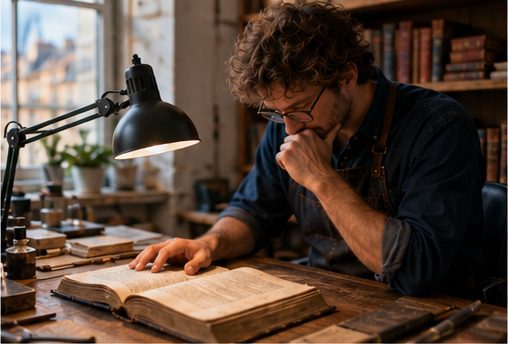
Je m’appelle Julien. Je suis restaurateur de livres anciens. Je travaille à Bordeaux, dans un petit atelier.
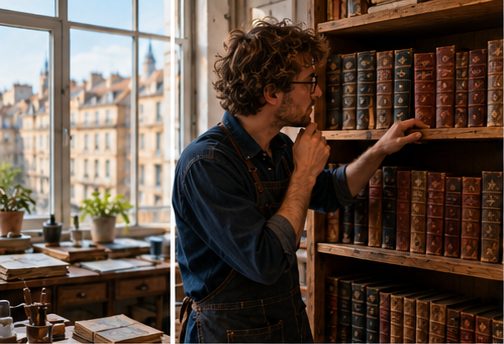
Le matin, je choisis un livre sur l’étagère. Je réfléchis longtemps avant de commencer. Ici, on ne travaille pas vite.

Je finis un livre en trois semaines, parfois en trois mois. Je suis heureux quand un vieux livre retrouve sa beauté. Je ne donne pas une nouvelle vie à ces livres. Je donne du temps. Quand le livre est très abîmé, je réussis à lui donner une nouvelle forme.
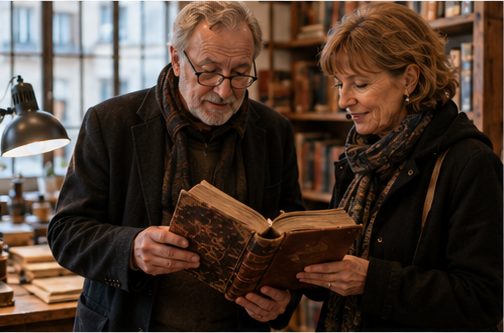
Mes clients réfléchissent aussi : ils choisissent souvent un livre avec une histoire spéciale.
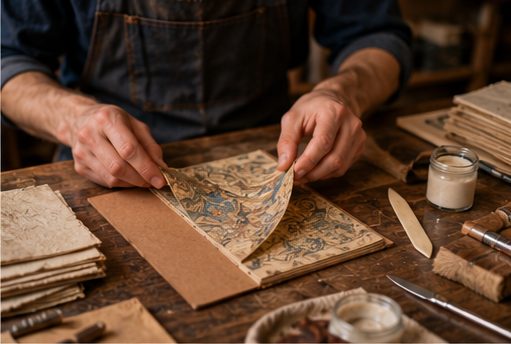
L’après-midi, je choisis le papier et je prépare une nouvelle couverture.

Le soir, je finis à six heures et je rentre à pied.
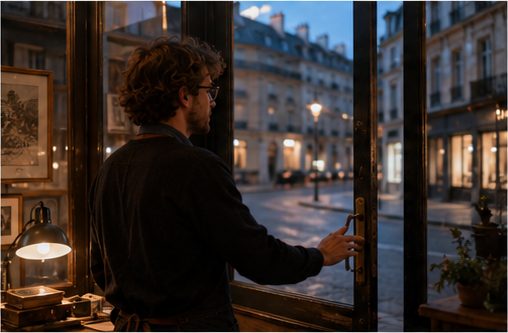
Le vendredi, je finis plus tôt. Je ferme l’atelier et je retrouve mes amis pour passer une bonne soirée.

Ce vendredi, c’est l’anniversaire de mon meilleur ami. Nous finissons le travail tôt et nous allons fêter son anniversaire dans un restaurant Michelin de notre ville.
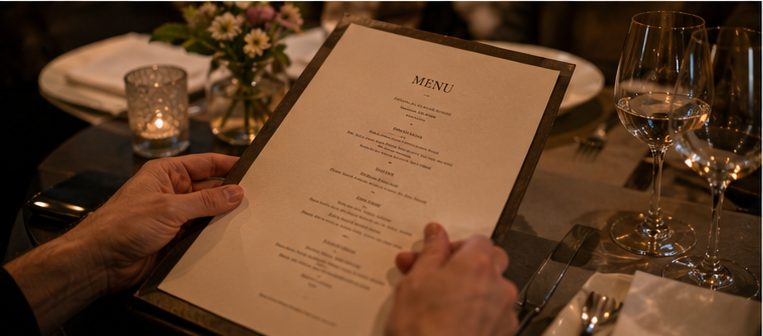
Nous choisissons nos plats et nous hésitons longtemps avant de choisir le dessert.
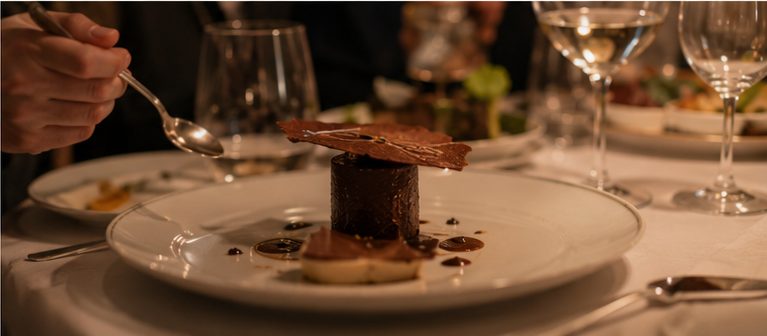
Je pense que nous allons passer une très bonne soirée !
Four verbs of the new family carry this text: choisir, réfléchir, finir, réussir. The dialogue below adds the others. Everything else you already know from Épisode 1. My name is Julien. I am a restorer of old books. I work in Bordeaux, in a small workshop. In the morning I choose a book from the shelf. I think for a long time before I start. Here we do not work fast. I finish a book in three weeks, sometimes in three months. I am happy when an old book finds its beauty again. I do not give these books a new life. I give them time. When a book is very damaged, I manage to give it a new shape. My clients think it over too: they often choose a book with a special story. In the afternoon I choose the paper and prepare a new cover. In the evening I finish at six and I walk home. On Fridays I finish earlier. I close the workshop and I meet my friends for a good evening together. This Friday it is my best friend's birthday. We finish work early and we are going to celebrate his birthday in a Michelin restaurant in our town. We choose our dishes and we hesitate for a long time before choosing the dessert. I think we are going to have a very good evening!
Les mots du texte
| Français | English | Français | English |
|---|---|---|---|
| un atelier | a workshop | le papier | paper |
| une étagère | a shelf | une couverture | a cover |
| un livre ancien | an old book | abîmé | damaged |
| la beauté | beauty | une forme | a shape |
| une histoire | a story | heureux | happy |
| à pied | on foot | plus tôt | earlier |
| fermer | to close | retrouver | to meet up with |
| une soirée | an evening out | un anniversaire | a birthday |
| fêter | to celebrate | mon meilleur ami | my best friend |
| un menu | a set menu | un plat | a dish, a course |
| un dessert | a dessert | hésiter | to hesitate |
| un outil | a tool | un pinceau | a brush |
| la colle | glue | le dos du livre | the spine |
La semaine de Julien en neuf photos
Hide the sentences, look at the photos and tell his week out loud. First with je, as Julien. Then with il, as if you were describing him to a friend. With the sentences hidden, click any single photo to check just that one.
À l’atelier — Julien et une cliente
Cliente : Bonjour. Vous restaurez les livres de famille ?
Julien : Oui, bien sûr. Vous apportez quel livre ?
Cliente : L’atlas de mon grand-père. Le papier jaunit et la couverture noircit.
Julien : D’accord. Vous choisissez une restauration complète ou une réparation simple ?
Cliente : Je réfléchis… Vous finissez quand ?
Julien : Pour un atlas, nous finissons en deux mois. Nous ne travaillons pas vite, mais nous garantissons le résultat.
Cliente : Et vous réussissez toujours ?
Julien : Non, pas toujours. Mais j’avertis le client avant de commencer.
Cliente : Très bien. Je choisis la restauration complète.
The rule
Take the infinitive, drop -ir, add the ending. In the three plural forms an extra -iss- appears before the ending. That syllable is the signature of this family.
| Pronom | fin-ir | Sound | English |
|---|---|---|---|
| je | finis | /fi.ni/ | I finish |
| tu | finis | /fi.ni/ | you finish (informal) |
| il / elle / on | finit | /fi.ni/ | he, she finishes |
| nous | finissons | /fi.ni.sɔ̃/ | we finish |
| vous | finissez | /fi.ni.se/ | you finish (polite / plural) |
| ils / elles | finissent | /fi.nis/ | they finish |
The good news for your ear. The three singular forms sound identical: je finis, tu finis, il finit are all /fi.ni/.
The important difference from Épisode 1. With -er verbs you cannot hear the plural: il parle and ils parlent are the same sound. With this family you can: il finit /fi.ni/ but ils finissent /fi.nis/.
So the little /s/ at the end tells you: one person or several.
Groupe 1 et groupe 2, côte à côte
| Pronom | parler (groupe 1) | finir (groupe 2) |
|---|---|---|
| je | parle | finis |
| tu | parles | finis |
| il / elle / on | parle | finit |
| nous | parlons | finissons |
| vous | parlez | finissez |
| ils / elles | parlent | finissent |
Careful: not every verb in -ir belongs here.
venir, partir, sortir, dormir, ouvrir end in -ir but follow other rules. They belong to the third group.
The test is the nous form. If it has -issons, the verb is in this lesson: nous finissons, nous choisissons. If not, it is not: nous partons, nous dormons.
Les verbes du 2e groupe les plus utiles
| Infinitif | English | Exemple |
|---|---|---|
| finir | to finish | Je finis à six heures. |
| choisir | to choose | Je choisis le papier. |
| réfléchir | to think it over | Je réfléchis avant de répondre. |
| réussir (à) | to succeed, to manage | Je réussis à finir avant six heures. |
| remplir | to fill, to fill in | Je remplis le formulaire. |
| garantir | to guarantee | Nous garantissons le résultat. |
| avertir | to warn | J’avertis le client. |
| ralentir | to slow down | Ici, on ralentit. |
| applaudir | to applaud | Nous applaudissons à la fin. |
| agir | to act | Je réfléchis, puis j’agis. |
De l’adjectif au verbe
Many verbs of this family are simply an adjective plus -ir. They describe a slow change, which is why a restorer needs them all day long.
La négation
Exactly as in Épisode 1: the verb goes inside the ne … pas sandwich.
Nous réussissons toujours. → Nous ne réussissons pas toujours.
Les verbes du texte — listen and repeat
- Je choisis un livre sur l’étagère. /ʒə ʃwa.zi œ̃ livʁ syʁ le.ta.ʒɛʁ/ I choose a book from the shelf.
- Je réfléchis longtemps avant de commencer. /ʒə ʁe.fle.ʃi lɔ̃.tɑ̃ a.vɑ̃ də kɔ.mɑ̃.se/ I think it over for a long time before starting.
- Je finis un livre en trois semaines. /ʒə fi.ni œ̃ livʁ ɑ̃ tʁwa sə.mɛn/ I finish a book in three weeks.
- Je réussis à lui donner une nouvelle forme. /ʒə ʁe.y.si a lɥi dɔ.ne yn nu.vɛl fɔʁm/ I manage to give it a new shape.
- Mes clients réfléchissent aussi. /me kli.jɑ̃ ʁe.fle.ʃis o.si/ My clients think it over too.
- Ils choisissent un livre avec une histoire spéciale. /il ʃwa.zis œ̃ livʁ a.vɛk yn is.twaʁ spe.sjal/ They choose a book with a special story.
- Le vendredi, je finis plus tôt. /lə vɑ̃.dʁə.di ʒə fi.ni ply to/ On Fridays I finish earlier.
- Nous finissons le travail tôt. /nu fi.ni.sɔ̃ lə tʁa.vaj to/ We finish work early.
- Nous choisissons nos plats. /nu ʃwa.zi.sɔ̃ no pla/ We choose our dishes.
- Nous hésitons avant de choisir le dessert. /nu.ze.zi.tɔ̃ a.vɑ̃ də ʃwa.ziʁ lə de.sɛʁ/ We hesitate before choosing the dessert.
- Le papier jaunit. /lə pa.pje ʒo.ni/ The paper turns yellow.
- Nous garantissons le résultat. /nu ɡa.ʁɑ̃.ti.sɔ̃ lə ʁe.zyl.ta/ We guarantee the result.
- Vous finissez à quelle heure ? /vu fi.ni.se a kɛ lœʁ/ What time do you finish?
- Vous choisissez quel dessert ? /vu ʃwa.zi.se kɛl de.sɛʁ/ Which dessert do you choose?
nous allons fêter is the near future: aller + infinitive, exactly like English we are going to celebrate. Learn it as a ready-made phrase here; the full pattern comes later in the course.
Complete the conjugation
Type the verb form only, without the pronoun. For example, nous finissons → type finissons.
Choose the correct form
Click an option and you get the answer straight away.
Complete the text
The same week, but now told about Julien. Put the verb in brackets into the correct form.
Associez la photo et la phrase
Click a photo, then click the sentence that goes with it. Every sentence is in the il form.
Regardez la photo et répondez
Three questions per photo: où, quoi, comment. Click an answer and you get the result straight away.
Le matinLes clientsLe vendredi soirLe dessertNon ! Corrigez
Look at the photo: the question is wrong. Say no, then say what is true. Remember the small rule: after ne … pas, the article un / une / du becomes de, while le / la does not change.
Exemple
Question : Il choisit un journal ?
Réponse : Non, il ne choisit pas de journal. Il choisit un livre.
Le matinAvant de commencerLes clientsL’après-midiLe vendrediLa soiréeVrai ou faux ? — L’atelier de Julien
Read the text again, then decide: true or false?
Vrai ou faux ? — À l’atelier
Now read the dialogue between Julien and the client, and decide: true or false?
Répondez aux questions
Answer with a short phrase, as in the example. A full sentence is accepted too.
Exemple
Question : Julien travaille où ?
Réponse : À Bordeaux. (or: Il travaille à Bordeaux.)
Which form sounds different?
Listen to each row and choose the one form that does not sound like the other three. Remember: with this family, the plural ils form ends in a clear /s/.
Ask the question with « vous »
Exemple
Julien : Je travaille à Bordeaux.
Vous : Vous travaillez à Bordeaux ?
Décrivez la photo
Answer the questions out loud, in full sentences, before you click. The card then shows one possible answer. Yours does not have to be the same.
Qui est sur la photo ? Qu’est-ce qu’ils regardent ? Ils choisissent vite ?Qu’est-ce qu’il prépare ? Il travaille avec quoi ?Quel jour est-ce ? Qu’est-ce qu’il fait ? Il finit tôt ou tard ?Où sont-ils ? Qu’est-ce qu’ils fêtent ? Ils sont combien ?Qu’est-ce que c’est ? Qu’est-ce qu’on choisit ici ?Qu’est-ce que c’est ? C’est le début ou la fin du repas ?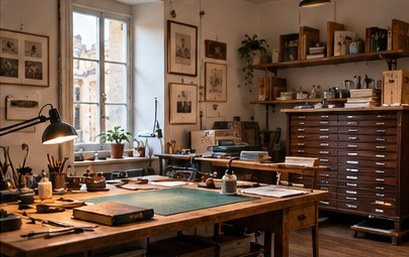 C’est quoi ? Qu’est-ce qu’on voit sur la table ? C’est calme ou bruyant ?
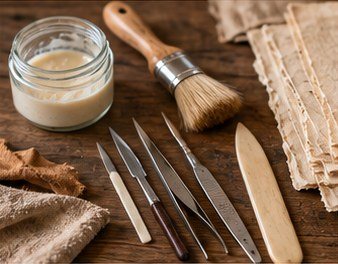 Qu’est-ce que c’est ? Julien choisit quel outil ?
In pairs: one asks the questions, the other describes the photo, then swap.
Et vous ?
Say your own answer out loud in a full sentence first, then click the card to see a model answer.
In pairs: one asks with vous, the other answers with je, then swap.
Production écrite
five about your working day (what you choose, what you think over, when you finish),
and three about your Friday evening (who you meet, where you go, what you choose there).
Use at least six verbs of the second group, two sentences with nous, one sentence with réussir à + infinitive, and one negative sentence with ne … pas.
Plan de l’épisode (нотатки для викладача, 60 хв)
| Час | Етап | Що робимо |
|---|---|---|
| 4 хв | Lead-in | Банер над текстом: C’est qui ? Il travaille où ? Виходимо на професію Жюльєна і на ідею повільної роботи. |
| 7 хв | Reading for gist | Читають текст один раз, з фото поруч із кожним абзацом. Два запитання: Pourquoi Julien travaille lentement ? та Qu’est-ce qu’il fait le vendredi ? Далі Exercice 7 (vrai / faux). |
| 4 хв | Vocabulary check | Exercice 4: зіставлення фото і речень у формі il. Швидка перевірка розуміння без перекладу. |
| 6 хв | Photo questions | Exercice 5 спершу усно, потім кліками: майстерня, клієнти, ресторан, десерт. |
| 6 хв | Reading for detail | Exercice 9: короткі відповіді на запитання до тексту. Тут учень уперше сам продукує форми il та ils письмово. |
| 12 хв | Language focus | Учень сам виписує з тексту дієслова на -ir і помічає вставку -iss- у множині. Далі таблиця finir, порівняння з parler, конструкція réussir à + infinitif і попередження про partir, sortir, dormir (тест через форму nous). |
| 5 хв | Drilling | Exercice 10 на слух: головне протиставлення il finit та ils finissent. Потім картки «listen and repeat». |
| 8 хв | Controlled practice | Exercices 1 і 3. Самоперевірка кнопкою «Vérifier», викладач працює лише з проблемними місцями. |
| 5 хв | Negation | Exercice 6 за фото: спершу усно хором, потім письмово. Тут же коротко правило un / une → de після ne … pas. |
| 3 хв | Semi-controlled | Exercice 11: перетворення je у vous. Це міст до вільного мовлення. |
| — | Devoirs | Смуга з дев’яти фото з прихованими підписами: переказ тижня через je і через il. Плюс Exercices 2, 8, 12 і 13, а також Production écrite «Ma semaine, lentement». |
Anticipated problems: 1) учень забуває вставку -iss- у множині (ils finent); 2) переносить правило першої групи і не чує різниці il finit та ils finissent; 3) вважає, що всі дієслова на -ir ідуть за цим правилом (je pars, je dors); 4) вимовляє s у формах однини; 5) для англомовного учня варто окремо показати, що je finis покриває і «I finish», і «I am finishing»; 6) забуває à після réussir перед інфінітивом (je réussis donner); 7) плутає avant de + infinitif та réussir à + infinitif — варто винести обидві конструкції на дошку поруч.