Je me lève, tu te lèves
Half past four, a silent old man, and the only boat on the water.
Tuesday, before dawn. Marc tells this one himself, as he did in Épisode 3: the same man, the same water, but this time he is not alone. Lucien is already waiting at the harbour, and today he has something to say. For Lucien, it is a great deal.
Texte
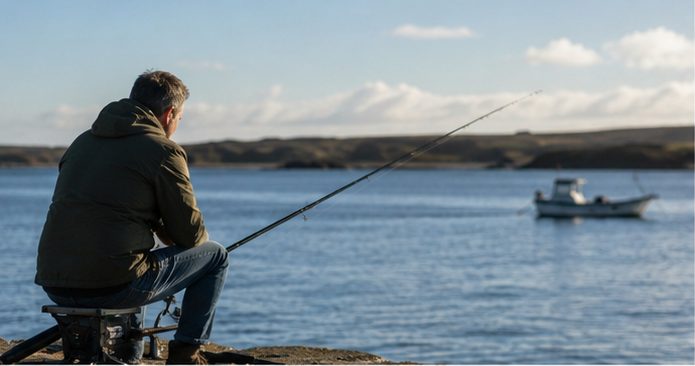
Le rocher noir
Mardi. Quatre heures et demie du matin. Mon réveil sonne.
Je me réveille. Il fait nuit. Je ne me lève pas tout de suite : je pense à Émile, à Gustave et au rocher noir.
Puis je me lève. Je me lave le visage à l’eau froide et je m’habille vite. Pas de café : il est trop tôt, même pour Véronique.
À cinq heures moins cinq, j’arrive au port. Lucien est déjà là, dans son bateau. Lucien se lève à quatre heures, tous les jours, depuis soixante-dix ans. Les autres pêcheurs se lèvent plus tard.
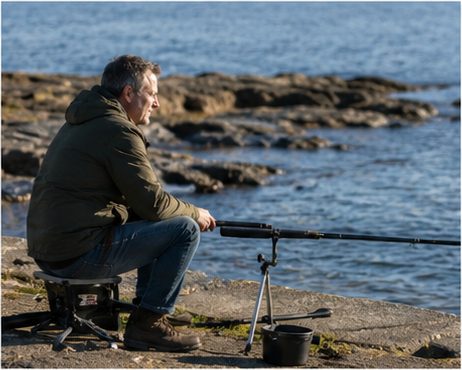
Nous partons. Le bateau avance doucement sur l’eau noire. Lucien ne parle pas. Moi non plus. Après vingt minutes, nous arrivons au rocher. Nous nous installons et nous attendons.
Le soleil se lève. La mer est calme. Personne ne parle.
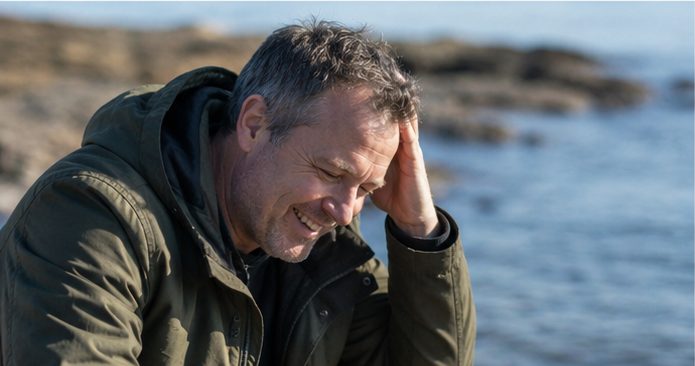
Pour la première fois de la semaine, je me sens bien.
Sur le bateau
Lucien : Tu te lèves tard, toi.
Marc : Il est cinq heures !
Lucien : Justement.
Marc : Vous vous levez à quelle heure, vous ?
Lucien : Quatre heures.
(Une heure passe.)
Marc : Ça mord, d’habitude ?
Lucien : Chut.
(Encore une heure.)
Lucien : Ici, c’est le rocher d’Émile. Je viens ici tous les mardis. Avec lui, avant. Seul, maintenant.
Marc : Et aujourd’hui… pourquoi moi ?
Lucien : Véronique. Elle parle de toi.
Marc : De moi ?
Lucien : Beaucoup.
Marc : …
Marc : Lucien ! Ça mord ! Ça mord !
Lucien : Doucement. Doucement…
Hover any word for its sound and its English, or read the whole text in English first. Tuesday. Half past four in the morning. My alarm clock rings. I wake up. It is dark. I do not get up straight away: I think about Émile, about Gustave and about the black rock. Then I get up. I wash my face in cold water and I get dressed quickly. No coffee: it is too early, even for Véronique. At five to five I get to the harbour. Lucien is already there, in his boat. Lucien gets up at four o’clock, every day, and has done for seventy years. The other fishermen get up later. We set off. The boat moves slowly over the black water. Lucien does not speak. Neither do I. After twenty minutes we reach the rock. We settle in and we wait. The sun rises. The sea is calm. Nobody speaks. For the first time this week, I feel good. ON THE BOAT. LUCIEN: You get up late, you do. MARC: It is five o’clock! LUCIEN: Exactly. MARC: And what time do you get up? LUCIEN: Four o’clock. (An hour goes by.) MARC: Are they usually biting? LUCIEN: Shh. (Another hour.) LUCIEN: This is Émile’s rock. I come here every Tuesday. With him, before. Alone, now. MARC: And today… why me? LUCIEN: Véronique. She talks about you. MARC: About me? LUCIEN: A lot. MARC: … MARC: Lucien! They’re biting! They’re biting! LUCIEN: Gently. Gently…
Mots et expressions
30 mots
| Français | English |
|---|---|
| le réveil | the alarm clock |
| sonner | to ring |
| se réveiller | to wake up |
| se lever | to get up |
| il fait nuit | it is dark |
| tout de suite | straight away |
| penser à | to think about |
| se laver le visage | to wash one’s face |
| l’eau froide | cold water |
| s’habiller | to get dressed |
| vite | quickly |
| trop tôt | too early |
| cinq heures moins cinq | five to five |
| déjà | already |
| depuis soixante-dix ans | for seventy years (and still) |
| plus tard | later |
| avancer | to move forward |
| doucement | gently, slowly |
| moi non plus | me neither |
| s’installer | to settle in |
| attendre | to wait |
| le soleil se lève | the sun rises |
| calme | calm |
| personne ne parle | nobody speaks |
| se sentir bien | to feel good |
| pour la première fois | for the first time |
| d’habitude | usually |
| avant · maintenant | before · now |
| Chut ! | Shh! |
| Ça mord ! | They’re biting! (fishing) |
Me, te, se: when the action comes back to you
Grammaire 1
Lever means to lift something. Se lever means to lift yourself: to get up. Marc can lever sa canne, lift his rod, and at half past four he has to se lever. French marks the difference with a second small pronoun that matches the first.
| Personne | se lever | sound |
|---|---|---|
| je | je me lève | /ʒə mə lɛv/ |
| tu | tu te lèves | /ty tə lɛv/ |
| il / elle / on | il se lève | /il sə lɛv/ |
| nous | nous nous levons | /nu nu lə.vɔ̃/ |
| vous | vous vous levez | /vu vu lə.ve/ |
| ils / elles | ils se lèvent | /il sə lɛv/ |
A small spelling note. Lever takes a grave accent when the ending is silent (je lève, ils lèvent) and loses it when the ending is heard (nous levons, vous levez). The accent is there to open the vowel: /lɛv/ against /lə.ve/. It is the boot of Épisode 7 once again.
The negative, the short forms and tomorrow
Grammaire 2
| Rule | Example |
|---|---|
| ne goes before the small pronoun, pas after the verb | je ne me lève pas |
| me, te, se lose their e before a vowel | je m’habille · tu t’installes · il s’arrête |
| in the near future, the pronoun stays with the infinitive | je vais me lever · nous allons nous installer |
The ones you now know:
| se réveiller | to wake up |
| se lever | to get up |
| se laver | to wash (oneself) |
| s’habiller | to get dressed |
| s’installer | to settle in, to sit down comfortably |
| se sentir bien | to feel good |
| s’appeler | to be called (Épisode 3) |
| s’arrêter | to stop (Épisode 9) |
| s’asseoir | to sit down (Épisode 8) |
How it really comes out
Ça mord ?
Every French fisherman asks it, and every one answers it: Ça mord ?, literally “is it biting?”, meaning “are they biting?”. Ça mord ! is the best sentence of Marc’s week.
Listen to Lucien: Tu te lèves tard, toi. The extra toi at the end changes nothing in the grammar and everything in the tone: “you, you get up late”. Marc does the same back: Vous vous levez à quelle heure, vous ?
And notice who says what. Lucien says tu; Marc says vous. Nobody is being rude: an old man, on his own boat, decides. Marc waits to be asked, which is exactly right.
Les expressions du texte · listen and repeat
Twelve sentences from the boat. Tap a card to turn it over, the speaker to hear it, the star to keep it in your word bank.
- Mon réveil sonne. /mɔ̃ ʁe.vɛj sɔn/ My alarm clock rings.
- Je me réveille. Il fait nuit. /ʒə mə ʁe.vɛj il fɛ nɥi/ I wake up. It is dark.
- Je ne me lève pas tout de suite. /ʒə nə mə lɛv pa tut sɥit/ I do not get up straight away.
- Je me lave le visage à l’eau froide. /ʒə mə lav lə vi.zaʒ a lo fʁwad/ I wash my face in cold water.
- Je m’habille vite. /ʒə ma.bij vit/ I get dressed quickly.
- Lucien se lève à quatre heures. /ly.sjɛ̃ sə lɛv a ka.tʁœʁ/ Lucien gets up at four.
- Nous nous installons et nous attendons. /nu nu.zɛ̃s.ta.lɔ̃ e nu.za.tɑ̃.dɔ̃/ We settle in and we wait.
- Le soleil se lève. /lə sɔ.lɛj sə lɛv/ The sun rises.
- Je me sens bien. /ʒə mə sɑ̃ bjɛ̃/ I feel good.
- Tu te lèves tard, toi. /ty tə lɛv taʁ twa/ You get up late, you do.
- Vous vous levez à quelle heure ? /vu vu lə.ve a kɛ.lœʁ/ What time do you get up?
- Ça mord ! /sa mɔʁ/ They’re biting!
Me, te, se, nous ou vous ?
The small pronoun always matches the subject. One per gap.
Quelle forme ?
Now the verb itself. Watch the accent of lever, and the boot.
Le matin de Marc
Write the small pronoun and the verb together, for example me lève or m’habille.
Dans quel ordre ?
Only one sentence in each group is French. Where do ne, the small pronoun and pas go?
Regardez la photo et répondez
Tuesday at dawn, in three pictures.
Au portAu rocherPour la première foisVrai ou faux ?
Read the text again and decide.
Qui parle ?
Two men in a boat. The one who says tu, or the one who says vous?
Et vous, le matin ?
Finish each sentence out loud about your own mornings. Then click the card for one possible answer : yours will be different.
In pairs: one asks, the other answers, then swap.
Production écrite
Use six different verbs with me, te, se, one negative (je ne me… pas), and finish with one sentence about tomorrow: Demain, je vais me lever à cinq heures. Comme Lucien.
Plan de l’épisode (нотатки для викладача, 60 хв)
| Час | Етап | Що робимо |
|---|---|---|
| 5 хв | Lead-in | Викладач питає: Vous vous levez à quelle heure ? і показує жестами «прокидатися», «вставати», «одягатися». Група відповідає як уміє. |
| 7 хв | Reading for gist | Читають текст і діалог. Одне запитання: Pourquoi Lucien prend Marc avec lui ? Далі Exercice 6. |
| 9 хв | Me, te, se | Граматика 1: lever і se lever, таблиця, наголос у lève / levons. Exercice 1. |
| 7 хв | Drill | Exercice 2 усно ланцюжком, потім Exercice 3 письмово. |
| 7 хв | Ne… pas, m’, demain | Граматика 2 і Exercice 4. Окремо пастка je me lave le visage. |
| 13 хв | Speaking | «Mon matin» ланцюжком: кожен додає одну дію з se, наступний повторює всі попередні. Потім у парах: розіграти «Sur le bateau»; Lucien говорить не більше трьох слів за раз. |
| 7 хв | Photos | Exercice 5 у парах. |
| 5 хв | Wrap-up | Exercice 7 на слух і блок «Ça mord ?». Питання на наступний раз: Qu’est-ce que Marc va prendre ? Домашнє: Production écrite і Exercice 8. |