Du pain, pas de poisson
Market day, a shopping list with no fish on it, and a goldfish who knows where to look.
Monday is market day. Véronique decides to throw a farewell party on Tuesday night, because on Wednesday everybody leaves, and she writes a shopping list with one striking gap in it. While the others go shopping, Marc stays behind with Gustave, sits down at the goldfish’s height, and at last does what Émile asked.
Les personnages
1 nouvelle
La fromagère, the cheese seller at the Monday market. She has known Véronique for twenty years, she calls every customer by name, and she asks every one of them the same two questions.
Texte
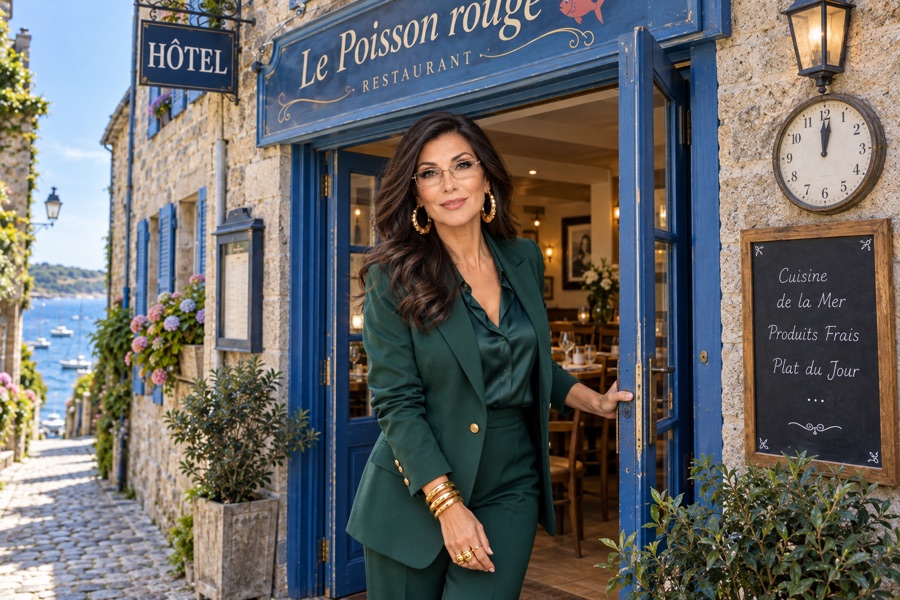
Le jour du marché
Lundi, c’est le jour du marché. Véronique a une idée : demain soir, au Poisson rouge, il y a une fête. Une fête d’adieu, parce que mercredi, tout le monde part.
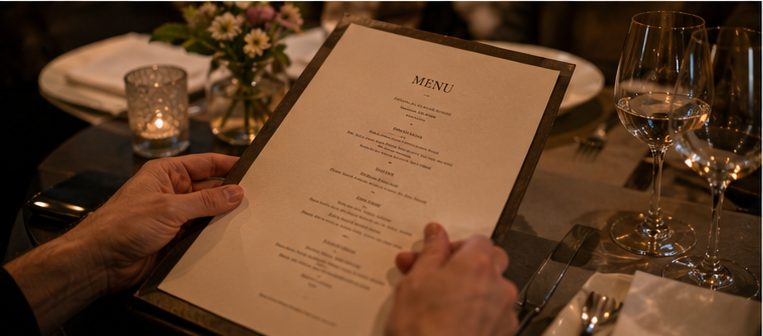
Elle fait une liste : du pain, du fromage, de la crème, de l’huile d’olive, des tomates et des fraises. Pas de viande. Et pas de poisson.
Pas de poisson ? Dans un restaurant qui s’appelle « Le Poisson rouge » ?
« Le poisson, dit Véronique, c’est Marc. » Marc devient tout blanc.
Véronique, Camille et Théo vont au marché. Il y a du monde. Il y a des fruits, des légumes, du fromage, de la viande et, bien sûr, du poisson. Théo regarde le poisson. Longtemps.
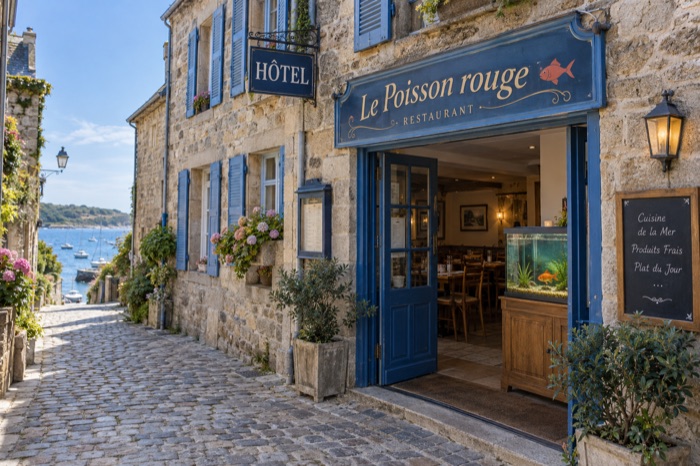
Marc, lui, reste seul au restaurant. Il s’assoit à côté de l’aquarium, à la hauteur de Gustave, et il regarde. Gustave ne regarde pas la porte. Il ne regarde pas la salle. Il regarde toujours la fenêtre.
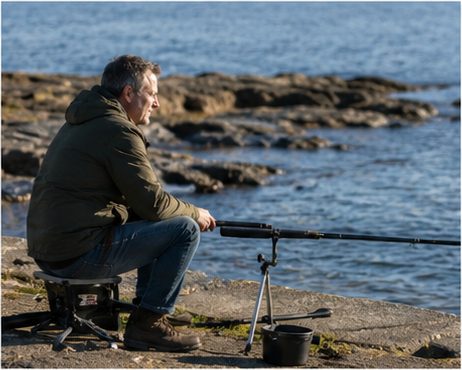
Marc regarde avec lui. Derrière la fenêtre, il y a la plage. Ce matin, c’est la marée basse. Et au bout de la plage, dans l’eau, il y a un rocher. Un rocher noir.
« Les yeux du poisson rouge… », dit Marc tout bas.
À ce moment-là, la porte s’ouvre. C’est Lucien. Au village, les nouvelles vont vite : Théo parle à Inès, et Inès parle à son grand-père.
Au marché
La fromagère : Bonjour, Véronique ! Qu’est-ce que je vous sers ?
Véronique : Bonjour ! Du comté, s’il vous plaît. Et du chèvre.
La fromagère : Et avec ceci ?
Véronique : De la crème fraîche. Un grand pot.
Camille : Et moi, je voudrais des œufs, s’il vous plaît.
La fromagère : Six ou douze ?
Camille : Six, merci.
Théo : Et du poisson ? Faut du poisson pour une fête, non ?
Véronique : Pas de poisson. Marc apporte le poisson.
Théo : Marc ? Alors demain, on ne mange pas de poisson !
Camille : Théo !
La fromagère : Ce sera tout ?
Véronique : Ce sera tout, merci.
Au restaurant
Lucien : Demain. Cinq heures. Au port.
Marc : Cinq heures… du matin ?
Lucien : Ben oui.
(Lucien part.)
Marc : Merci, Gustave.
Hover any word for its sound and its English, or read the whole text in English first. Monday is market day. Véronique has an idea: tomorrow evening, at Le Poisson rouge, there is going to be a party. A farewell party, because on Wednesday everybody leaves. She makes a list: bread, cheese, cream, olive oil, tomatoes and strawberries. No meat. And no fish. No fish? In a restaurant called "Le Poisson rouge"? "The fish," says Véronique, "is Marc’s job." Marc goes pale. Véronique, Camille and Théo go to the market. It is busy. There is fruit, there are vegetables, cheese, meat and, of course, fish. Théo looks at the fish. For a long time. Marc, for his part, stays alone in the restaurant. He sits down next to the fish tank, at Gustave’s height, and he looks. Gustave does not look at the door. He does not look at the dining room. He always looks at the window. Marc looks with him. Behind the window there is the beach. This morning it is low tide. And at the end of the beach, in the water, there is a rock. A black rock. "The eyes of the goldfish…" Marc says very quietly. At that moment the door opens. It is Lucien. In the village news travels fast: Théo talks to Inès, and Inès talks to her grandfather. AT THE MARKET. CHEESE SELLER: Good morning, Véronique! What can I get you? VÉRONIQUE: Good morning! Some comté, please. And some goat’s cheese. CHEESE SELLER: Anything else? VÉRONIQUE: Some crème fraîche. A big tub. CAMILLE: And I would like some eggs, please. CHEESE SELLER: Six or twelve? CAMILLE: Six, thank you. THÉO: And fish? You need fish for a party, don’t you? VÉRONIQUE: No fish. Marc is bringing the fish. THÉO: Marc? Then tomorrow we are not eating any fish! CAMILLE: Théo! CHEESE SELLER: Will that be all? VÉRONIQUE: That will be all, thank you. AT THE RESTAURANT. LUCIEN: Tomorrow. Five o’clock. At the harbour. MARC: Five o’clock… in the morning? LUCIEN: Well, yes. (Lucien leaves.) MARC: Thank you, Gustave.
Mots et expressions
30 mots
| Français | English |
|---|---|
| le jour du marché | market day |
| une fête d’adieu | a farewell party |
| une liste | a list |
| le pain | bread |
| le fromage | cheese |
| la crème fraîche | crème fraîche, thick cream |
| l’huile d’olive | olive oil |
| une tomate | a tomato |
| une fraise | a strawberry |
| la viande | meat |
| les fruits, les légumes | fruit, vegetables |
| un œuf, des œufs | an egg, eggs |
| le comté, le chèvre | comté (a hard cheese), goat’s cheese |
| un pot | a pot, a tub |
| apporter | to bring |
| il y a du monde | it is busy, there are a lot of people |
| devenir tout blanc | to go pale |
| seul, seule | alone |
| à la hauteur de | at the level of, at the height of |
| la marée basse | low tide |
| au bout de la plage | at the end of the beach |
| tout bas | very quietly |
| à ce moment-là | at that moment |
| les nouvelles vont vite | news travels fast |
| la fromagère | the cheese seller |
| Qu’est-ce que je vous sers ? | What can I get you? |
| Et avec ceci ? | Anything else? |
| Ce sera tout ? | Will that be all? |
| je voudrais | I would like |
| il faut | we need, you need; you must |
Du, de la, des: “some”
Grammaire 1
English can say bread, some bread or the bread. French never leaves a noun on its own. When you mean an amount of something, not the whole of it and not a number you can count, it puts a small word in front.
| before… | use | Dans le texte |
|---|---|---|
| a masculine noun | du | du pain, du fromage, du poisson |
| a feminine noun | de la | de la crème, de la viande |
| a vowel | de l’ | de l’huile d’olive, de l’eau |
| a plural noun | des | des tomates, des fraises, des œufs |
Pas de poisson !
Grammaire 2
After a negative, all four shrink to one small word: de, or d’ before a vowel.
| oui | non |
|---|---|
| Il y a du poisson. | Il n’y a pas de poisson. |
| Elle achète de la viande. | Elle n’achète pas de viande. |
| On a de l’eau. | On n’a pas d’eau. |
| Je veux des fraises. | Je ne veux pas de fraises. |
How it really comes out
Et avec ceci ?
Three sentences run every market and every shop in France. The seller says them; you only need to recognise them.
Qu’est-ce que je vous sers ? · What can I get you?
Et avec ceci ? · Anything else?
Ce sera tout ? · Will that be all?
You answer with je voudrais, the polite cousin of je veux, and finish with Ce sera tout, merci.
One more thing you will hear: il faut loses its il in speech. Faut du poisson ! means il faut du poisson, we need fish.
Les expressions du texte · listen and repeat
Twelve sentences from market day. Tap a card to turn it over, the speaker to hear it, the star to keep it in your word bank.
- Demain soir, il y a une fête. /də.mɛ̃ swaʁ i.li.ja yn fɛt/ Tomorrow evening there is a party.
- Il faut du pain et du fromage. /il fo dy pɛ̃ e dy fʁɔ.maʒ/ We need bread and cheese.
- Pas de viande, et pas de poisson. /pa də vjɑ̃d e pa də pwa.sɔ̃/ No meat, and no fish.
- Le poisson, c’est Marc. /lə pwa.sɔ̃ sɛ maʁk/ The fish is Marc’s job.
- Il y a du monde au marché. /i.li.ja dy mɔ̃d o maʁ.ʃe/ The market is busy.
- Qu’est-ce que je vous sers ? /kɛs.kə ʒə vu sɛʁ/ What can I get you?
- Du comté, s’il vous plaît. /dy kɔ̃.te sil vu plɛ/ Some comté, please.
- Et avec ceci ? /e a.vɛk sə.si/ Anything else?
- Je voudrais des œufs. /ʒə vu.dʁɛ de.zø/ I would like some eggs.
- Ce sera tout, merci. /sə sə.ʁa tu mɛʁ.si/ That will be all, thank you.
- Ce matin, c’est la marée basse. /sə ma.tɛ̃ sɛ la ma.ʁe bɑs/ This morning it is low tide.
- Demain. Cinq heures. Au port. /də.mɛ̃ sɛ̃.kœʁ o pɔʁ/ Tomorrow. Five o’clock. At the harbour.
Du, de la, de l’ ou des ?
Véronique’s list, item by item. Masculine, feminine, a vowel, or more than one?
Pas de…
Say no. One word per gap: usually de or d’, but watch for être.
Le ou du ?
In general, or some of it? The English in brackets decides.
Au marché, qu’est-ce qu’on dit ?
Six moments at a market stall. Choose what is said.
Regardez la photo et répondez
Monday morning in three pictures.
La listeGustaveAu bout de la plageVrai ou faux ?
Read the text again and decide.
Qui parle ?
At the market and at the restaurant. Who says each line?
Et chez vous ?
Finish each sentence out loud about your own kitchen and your own shopping. Then click the card for one possible answer : yours will be different.
In pairs: one is the seller, the other the customer. Then swap.
Production écrite
Then add four sentences: two about what there is going to be at the party, and two about what there is not: Il ne va pas y avoir de viande, mais il va y avoir du fromage.
Plan de l’épisode (нотатки для викладача, 60 хв)
| Час | Етап | Що робимо |
|---|---|---|
| 5 хв | Lead-in | Питання групі: Qu’est-ce qu’il faut pour une fête ? Відповіді записуємо на дошці так, як їх кажуть; артиклі поки не виправляємо. |
| 7 хв | Reading for gist | Читають текст і діалоги. Одне запитання: Qu’est-ce que Gustave regarde ? Далі Exercice 6. |
| 9 хв | Du, de la, des | Граматика 1. Виправляємо список із дошки. Exercice 1. |
| 8 хв | Pas de | Граматика 2 і Exercice 2 письмово. Окремо два винятки: ce n’est pas du… і je n’aime pas le… |
| 5 хв | Le ou du | Exercice 3. Коротке правило: aimer з le, acheter з du. |
| 14 хв | Speaking | «Au marché»: половина групи продавці (сир, фрукти, риба), половина покупці зі списком. Обов'язково Qu’est-ce que je vous sers ?, Je voudrais…, Et avec ceci ?, Ce sera tout. Потім міняються. Перед грою Exercice 4. |
| 7 хв | Photos | Exercice 5 у парах. |
| 5 хв | Wrap-up | Exercice 7 на слух. Питання на наступний раз: Marc va prendre un poisson ? Домашнє: Production écrite і Exercice 8. |