Je viens de prendre un poisson !
The fish comes, the notebook ends, and Véronique says tu to one more person.
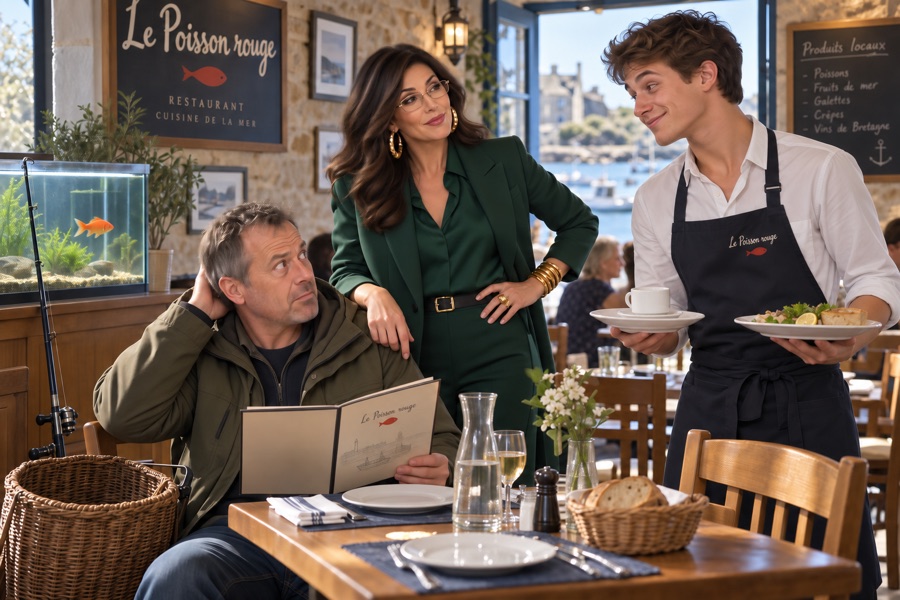
Tuesday evening, the farewell party. Everybody from the week is at Le Poisson rouge, the tables are full, and there is not a single fish on them. Véronique keeps looking at the door. Then it opens.
Texte
La fête
Mardi, huit heures du soir. Au Poisson rouge, tout le monde est là : Sophie et Camille, Julien, Théo et Inès, Lucien. Sur les tables, il y a du pain, du fromage, des tomates et des fraises. Mais il n’y a pas de poisson.

Véronique regarde la porte. Elle porte du vert et de l’or, comme toujours. Mais ce soir, elle porte aussi un petit sourire.
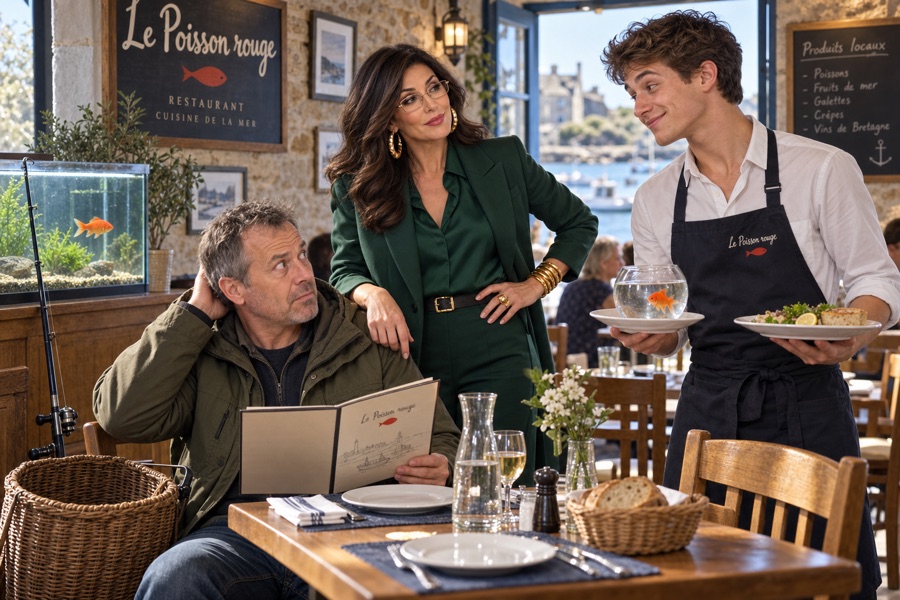
La porte s’ouvre. C’est Marc. Dans ses mains, il y a un grand bar.
Tout le monde applaudit. Théo applaudit plus fort que tout le monde.
Véronique prépare le bar au four, avec de l’huile d’olive et du citron. C’est le plat du jour. Le seul plat du jour.

Julien pose le carnet sur la table. Il vient de séparer la dernière page. Sur la page, il y a une phrase d’Émile. Marc lit la phrase trois fois.
Plus tard, Marc se lève. Il a quelque chose à dire.
Le bar
Marc : Je viens de prendre un poisson !
Théo : Sérieux ? Trop fort !
Lucien : Il vient de prendre un bar. Un beau.
Véronique : Bravo, monsieur… Bravo, Marc.
Julien : Et moi, je viens de finir le carnet. Regardez la dernière page.
Camille : « Le poisson vient toujours. Demain, peut-être. »
Marc : C’est ma phrase. Exactement ma phrase.
Samedi
Théo : Inès… Samedi, tu viens au ciné avec moi ?
Inès : Oui.
Théo : …
Inès : Théo ? Tu dis rien ?
Véronique : Enfin, le silence !
On se tutoie ?
Marc : J’ai une nouvelle. Je ne pars pas mercredi. Je vais rester encore une semaine. Et je vais revoir la maison bleue.
Sophie : Je viens de préparer les papiers.
Camille : Elle est trop forte.
Véronique : Marc… on se tutoie ?
Marc : Avec plaisir, Véronique.
Véronique : Alors, dis-moi : tu restes pour le poisson, ou pour le village ?
Marc : Pour le village. Et pour… le poisson rouge.
Théo : (à Inès, trop fort) Il parle pas de Gustave, hein.
Véronique : Théo !
Au Poisson rouge, il y a maintenant deux poissons qui ne partent jamais.
Hover any word for its sound and its English, or read the whole text in English first. Tuesday, eight o’clock in the evening. At Le Poisson rouge, everybody is here: Sophie and Camille, Julien, Théo and Inès, Lucien. On the tables there is bread, cheese, tomatoes and strawberries. But there is no fish. Véronique watches the door. She is wearing green and gold, as always. But tonight she is also wearing a little smile. The door opens. It is Marc. In his hands there is a big sea bass. Everybody claps. Théo claps louder than anybody. Véronique bakes the sea bass in the oven, with olive oil and lemon. It is the dish of the day. The only dish of the day. Julien puts the notebook on the table. He has just separated the last page. On the page there is one sentence from Émile. Marc reads it three times. Later, Marc stands up. He has something to say. THE SEA BASS. MARC: I have just caught a fish! THÉO: Seriously? Brilliant! LUCIEN: He has just caught a sea bass. A fine one. VÉRONIQUE: Well done, sir… Well done, Marc. JULIEN: And I have just finished the notebook. Look at the last page. CAMILLE: "The fish always comes. Tomorrow, maybe." MARC: That is my sentence. Exactly my sentence. SATURDAY. THÉO: Inès… are you coming to the cinema with me on Saturday? INÈS: Yes. THÉO: … INÈS: Théo? Aren’t you saying anything? VÉRONIQUE: Silence, at last! SHALL WE SAY TU? MARC: I have some news. I am not leaving on Wednesday. I am going to stay one more week. And I am going to see the blue house again. SOPHIE: I have just got the paperwork ready. CAMILLE: She is amazing. VÉRONIQUE: Marc… shall we say "tu"? MARC: With pleasure, Véronique. VÉRONIQUE: So, tell me: are you staying for the fish, or for the village? MARC: For the village. And for… the goldfish. THÉO: (to Inès, too loudly) He is not talking about Gustave, you know. VÉRONIQUE: Théo! At Le Poisson rouge there are now two fish who never leave.
Mots et expressions
30 mots
| Français | English |
|---|---|
| une fête | a party |
| tout le monde est là | everybody is here |
| la porte s’ouvre | the door opens |
| dans ses mains | in his hands |
| un bar | a sea bass |
| applaudir | to clap |
| plus fort que | louder than |
| au four | baked in the oven |
| le citron | lemon |
| le seul, la seule | the only one |
| venir de + infinitif | to have just (done something) |
| la dernière page | the last page |
| lire | to read |
| plus tard | later |
| avoir quelque chose à dire | to have something to say |
| Sérieux ? | Seriously? Really? |
| Trop fort ! | Brilliant! Amazing! |
| un beau poisson | a fine fish |
| Bravo ! | Well done! |
| Tu dis rien ? | Aren’t you saying anything? |
| Enfin, le silence ! | Silence, at last! |
| J’ai une nouvelle. | I have some news. |
| encore une semaine | one more week |
| revoir | to see again |
| les papiers | the paperwork |
| Elle est trop forte. | She is amazing. |
| se tutoyer | to say tu to each other |
| se vouvoyer | to say vous to each other |
| Avec plaisir. | With pleasure. |
| Dis-moi… | Tell me… |
Venir de: the moment just behind you
Grammaire 1
Aller + infinitive looks forward. Venir de + infinitive looks back: it says that something has only just happened. Only venir changes; the second verb stays in the infinitive, exactly as in Épisode 9.
| venir de | + infinitif | English |
|---|---|---|
| je viens de | prendre un poisson | I have just caught a fish |
| tu viens de | parler à Inès | you have just spoken to Inès |
| il vient de | séparer la page | he has just separated the page |
| nous venons de | dîner | we have just had dinner |
| vous venez d’ | arriver | you have just arrived |
| elles viennent de | préparer les papiers | they have just got the paperwork ready |
One verb, three moments, all made of things you already know:
| just now | now | soon |
|---|---|---|
| je viens de pêcher | je pêche | je vais pêcher |
Tu or vous: who decides
Grammaire 2
In France, tu is offered, never taken. Traditionally the older person, the woman, or the person on home ground offers it, and there is a set phrase for it: On se tutoie ? The two verbs are tutoyer (to say tu) and vouvoyer (to say vous).
| In the story | tu or vous, and why |
|---|---|
| Théo and Inès | tu: same age, old school friends |
| Sophie and Julien | tu: family |
| Théo to Lucien | vous: a young man to an old one |
| Lucien to Marc | tu: the old man, on his own boat, decides |
| Marc to Lucien | vous: nobody has offered him tu, so he waits |
| Véronique to Marc | vous for a week; tonight, tu, because she asks |
The season in one table
Récapitulatif
Six verbs carried most of the thirteen episodes. Here they are, all six persons, side by side.
| être | avoir | aller | faire | prendre | venir | |
|---|---|---|---|---|---|---|
| je | suis | ai | vais | fais | prends | viens |
| tu | es | as | vas | fais | prends | viens |
| il / elle / on | est | a | va | fait | prend | vient |
| nous | sommes | avons | allons | faisons | prenons | venons |
| vous | êtes | avez | allez | faites | prenez | venez |
| ils / elles | sont | ont | vont | font | prennent | viennent |
The four -ont verbs of Épisode 7 are all in the last row. And aller and venir are the two that also tell time: je vais + infinitive, je viens de + infinitive.
How it really comes out
Sérieux ? Trop fort !
Théo speaks like every nineteen-year-old in France: Sérieux ? (Really?), Trop fort ! (Brilliant!, literally “too strong”), Il parle pas de Gustave, hein, with no ne, of course. In young French trop often just means “very”: trop bon, trop bien, elle est trop forte.
Inès does the same: Tu dis rien ? And Théo’s question to her uses the plain present for a plan, as in Épisode 9: Samedi, tu viens au ciné avec moi ?
And the last line of the season. Marc stays pour le village, et pour… le poisson rouge. Le Poisson rouge is the restaurant; the goldfish is Gustave; and the woman who always wears gold is standing right in front of him. Théo, naturally, explains it to everybody.
Les expressions du texte · listen and repeat
Twelve sentences from the party. Tap a card to turn it over, the speaker to hear it, the star to keep it in your word bank.
- Tout le monde est là. /tu lə mɔ̃d ɛ la/ Everybody is here.
- Je viens de prendre un poisson ! /ʒə vjɛ̃ də pʁɑ̃dʁ œ̃ pwa.sɔ̃/ I have just caught a fish!
- Sérieux ? Trop fort ! /se.ʁjø tʁo fɔʁ/ Seriously? Brilliant!
- Il vient de prendre un bar. /il vjɛ̃ də pʁɑ̃dʁ œ̃ baʁ/ He has just caught a sea bass.
- Je viens de finir le carnet. /ʒə vjɛ̃ də fi.niʁ lə kaʁ.nɛ/ I have just finished the notebook.
- Le poisson vient toujours. /lə pwa.sɔ̃ vjɛ̃ tu.ʒuʁ/ The fish always comes.
- Samedi, tu viens au ciné avec moi ? /sam.di ty vjɛ̃ o si.ne a.vɛk mwa/ Are you coming to the cinema with me on Saturday?
- Enfin, le silence ! /ɑ̃.fɛ̃ lə si.lɑ̃s/ Silence, at last!
- Je ne pars pas mercredi. /ʒə nə paʁ pa mɛʁ.kʁə.di/ I am not leaving on Wednesday.
- Je viens de préparer les papiers. /ʒə vjɛ̃ də pʁe.pa.ʁe le pa.pje/ I have just got the paperwork ready.
- On se tutoie ? /ɔ̃ sə ty.twa/ Shall we say “tu”?
- Avec plaisir. /a.vɛk plɛ.ziʁ/ With pleasure.
Juste avant, maintenant ou bientôt ?
When does it happen? Look at the verb and at what follows it.
Quelle forme de venir ?
Everybody has just done something. Choose the form of venir.
Ça vient d’arriver
Write the form of venir and de (or d’ before a vowel), for example vient de.
Trois moments
The English tells you when. Choose the French.
Tu ou vous ? Toute la saison
Who says what to whom, at the end of the week?
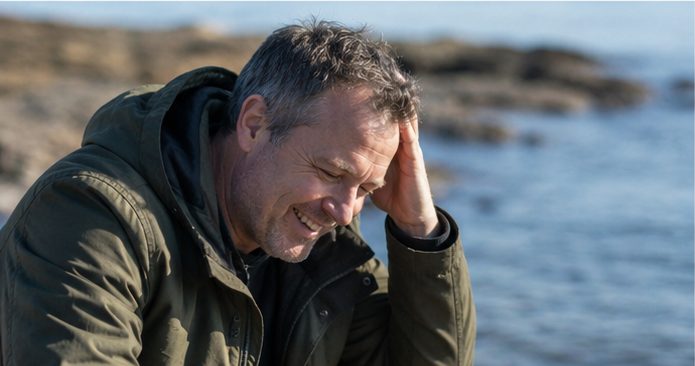
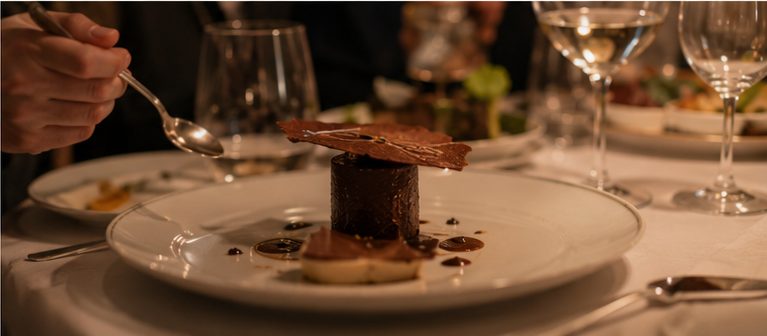
Associez la photo et la phrase
Click a photo, then the sentence from the party that goes with it.
Vrai ou faux ?
Read the text and the dialogues again, and decide.
Qui parle ?
The whole cast is at the party. Who says each line?
Et vous ?
The last conversation of the season. Finish each sentence out loud. Then click the card for one possible answer: yours will be different.
In pairs: one reads the beginning, the other finishes it, then swap.
Production écrite
Use venir de at least twice, aller + infinitive at least twice, and end with one short exchange between Véronique and Marc, now that they say tu: Marc vient de signer les papiers. Véronique : « Alors, tu vas rester ? »
Fin de la saison
Thirteen episodes ago you had one verb, être. Now you can tell a working day (Épisodes 1 to 3), speak to and about anyone (4 to 7), say where everybody is going (8), what they are going to do, and not do (9 and 10), what they buy (11), how their morning begins (12) and what has just happened (13).
All of it in the present tense, and all of it in a village you now know by heart. Save the words you want to keep in Mon vocabulaire.
Plan de l’épisode (нотатки для викладача, 60 хв)
| Час | Етап | Що робимо |
|---|---|---|
| 5 хв | Lead-in | Згадуємо кінець Épisode 12: Ça mord ! Питання: Marc va prendre un poisson ? Et Théo, il va parler à Inès ? Група робить прогнози з aller. |
| 8 хв | Reading for gist | Читають текст і три діалоги в ролях. Одне запитання: Qu’est-ce que Marc vient de prendre ? Далі Exercice 7. |
| 8 хв | Venir de | Граматика 1: таблиця, «три моменти» на дошці як лінія часу, пастка venir de + іменник. Exercice 1. |
| 7 хв | Drill | Exercice 2 усно, Exercice 3 письмово. Потім Exercice 4. |
| 6 хв | Tu / vous | Граматика 2 і Exercice 5. Обговорюємо: хто в групі кому пропонує «ти» у своїй мові і як. |
| 5 хв | Récap | Граматика 3: таблиця шести дієслів. Швидка гра: викладач каже дієслово і особу, група відповідає хором. |
| 14 хв | Speaking | «La fête»: кожен грає одного героя сезону і каже дві репліки: що він щойно зробив (venir de) і що збирається робити (aller). Інші вгадують, хто це. Далі Exercice 6 і 8. |
| 7 хв | Wrap-up | Exercice 9 по колу. Домашнє: Production écrite «Et après ?». Найкращі сцени можна прочитати на початку наступного заняття. |